Solar Parks in Romania: How They Work, How They Earn and the Largest Projects
What a solar park is, how it works and earns revenue in Romania, the steps from land to grid connection, and the largest solar parks with status and dates.
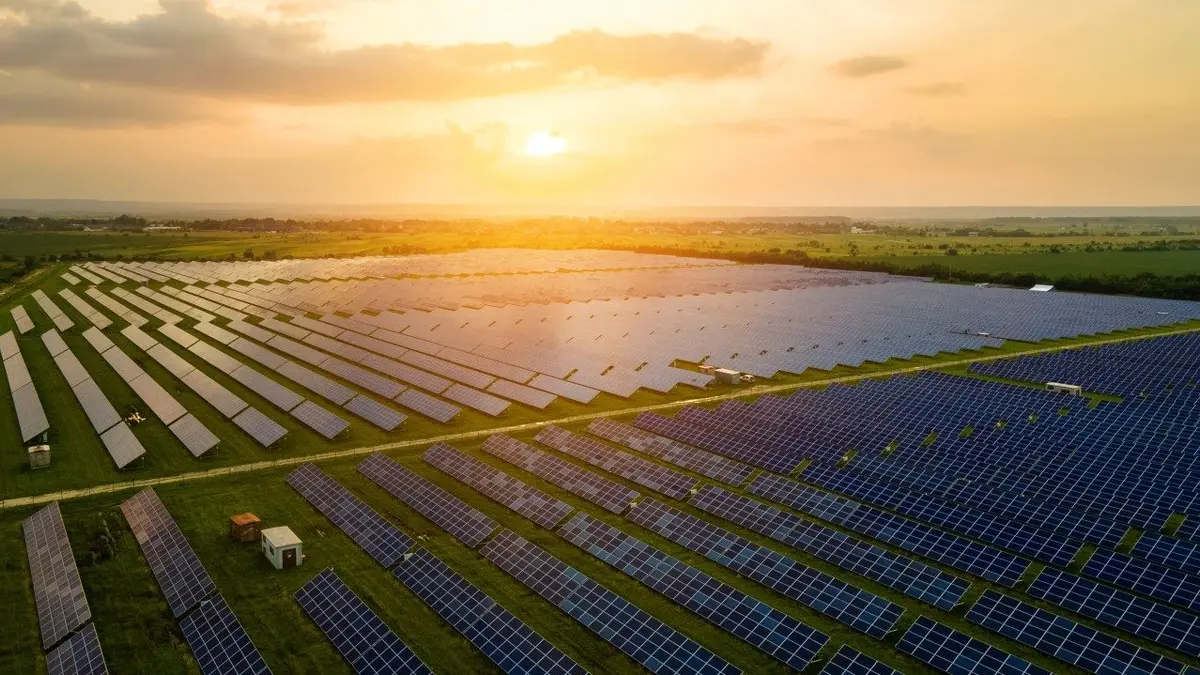
- A solar park (utility-scale photovoltaic plant) generates electricity only for sale: panels produce direct current, inverters convert it to alternating current, and transformers and a substation raise the voltage to that of the grid.
- Romania installed about 2.2 GW of solar in 2025, taking cumulative capacity past 7 GW, of which roughly 3.5 GW is utility-scale; a further 1,331 MW of photovoltaic capacity was connected between 1 January and 21 August 2026.
- Among solar parks whose start of operation has been publicly announced, the largest in Romania is Studina in Olt County (174 MWp, CWP Europe), followed by Iepurești in Giurgiu County (169 MWp, Nofar Energy); the largest authorised project is Dama Solar in Arad County (1.24 GWp), which targets 2028.
- Romanian solar parks sell their output through 15-year Contracts for Difference (round-2 solar averaged EUR 40.46/MWh), power purchase agreements or the OPCOM markets, and usually combine more than one of these.
- Since 21 May 2026, grid capacity requests carry a EUR 20,000 per MW guarantee under ANRE Order 15/2026, and Transelectrica now allocates capacity by area through auctions.
A solar park, also called a solar farm or utility-scale photovoltaic plant, is a large power station that converts sunlight into electricity and delivers it to the public grid for sale. In Romania such projects range from a few tens of megawatts to more than a gigawatt, are usually built on agricultural land outside built-up areas, and sell their output through Contracts for Difference (CfDs), power purchase agreements (PPAs) or directly on the market. This guide covers how a solar park works, the stages of a project, where the revenue comes from and which are the largest solar parks in Romania.
What is a solar park?
The difference from a prosumer system is purpose. Panels on a house or a warehouse roof produce mainly for the owner’s own consumption and export only the surplus; a solar park produces purely for sale. That is why it needs a grid connection, a licence from ANRE (Romanian Energy Regulatory Authority) and a strategy for selling its power. Scale has grown fast: Rătești, at 155 MWp, was Romania’s largest park in 2023, while the largest project authorised in 2026 exceeds 1.2 GWp.
How a solar park works, from panel to grid
The technical chain has five links:
- Photovoltaic modules turn light into direct current (DC). They sit on fixed mounting structures or on trackers that follow the sun; the 220 MW Vișina park uses more than 400,000 panels.
- Inverters convert direct current into alternating current (AC), the only form the grid accepts.
- Transformer stations raise the voltage to medium voltage, and an internal cable network collects the power from across the site.
- The project substation steps the voltage up to that of the grid the plant connects to: 110 kV on the distribution network, or 220 kV and 400 kV on Transelectrica’s transmission network, where Dama Solar will connect.
- SCADA monitoring and metering complete the chain. Increasingly, a battery is added on the same site to move part of the midday output into the evening.
MWp or MW? MWp (megawatt-peak) measures the panels’ direct-current output under standard test conditions; MW or MWac measures the power the inverters and the grid connection can actually deliver. Designers usually install more MWp than MWac so the plant produces more in the morning and evening, accepting some curtailment at the midday peak. Ogrezeni has 761 MWp and 534 MWac, and Dama Solar 1.24 GWp against a 1.07 GW grid connection. When comparing parks, compare like with like.
How much does a solar park produce? According to their developers, Rătești (155 MWp, about 170 hectares) is expected to generate around 220 GWh a year, Studina (174 MWp) about 245 GWh, and Vișina (220 MW, 354 hectares) about 400 GWh, the annual consumption of roughly 150,000 households.
How a solar park is built: from land to commissioning
A park goes through development (land, permits, grid connection), construction and commissioning; development is where a project’s fate is decided.
Land
Large projects are usually built on agricultural land outside built-up areas, either bought (sales follow the pre-emption procedure of Law 17/2014) or held under long-term superficies rights. Law 254/2022 introduced a simplified procedure for renewable energy projects on extra-urban agricultural land of quality classes III to V, capped at 50 hectares per project and, as adopted, applicable until 31 December 2026. Larger sites such as Vișina (354 hectares) or Dama Solar (1,064 hectares) need a heavier planning route. In 2026 the government also drafted a law to concession degraded state-owned farmland to renewable projects.
Permits and grid connection
Permitting runs through the urbanism certificate, environmental assessment, building permit and ANRE licensing; the sequence is well understood, but timelines vary by county. In parallel, the technical connection permit (ATR), issued by Transelectrica or the distribution operator, sets the connection point, capacity and required works; a connection contract follows and, at the end, a connection certificate.
The rules changed in 2026. Since 21 May, ANRE Order 15/2026 has required a participation guarantee of EUR 20,000 per MW for capacity allocation requests, and Transelectrica now allocates capacity by network area, through auctions, for generation and storage facilities of 5 MW or more. Sessions of the first grid capacity auction start on 30 October 2026. Large plants also need a setting-up authorisation from ANRE, for which the developer must show that construction financing is in place; Dama Solar obtained it in August 2026.
Construction, testing and licensing
The 13.3 MWp plant at Lunca Mureșului, Alba County, built by Momentum Energy as EPC contractor, went from start of works on 1 May 2026 to completion on 5 September 2026; the 126 MWp Văcărești park was built in under a year; for Dama Solar, Rezolv Energy expects a construction period of about three years.
Energisation is not yet commercial operation. After it come testing, the certificate of conformity, final acceptance, the connection certificate and the commercial operating licence issued by ANRE. Văcărești was completed in December 2025 and received its licence only in May 2026. For CfD projects the deadline is fixed: commercial operation within 36 months of contract signature.
How solar parks earn revenue in Romania
Contracts for Difference (CfDs). The state guarantees, for 15 years, the strike price won at auction: when the market price is below it, the generator receives the difference, and when the market is above, the generator pays it back. The scheme is financed with EUR 3 billion from the Modernisation Fund. Round 1 (December 2024) awarded 432 MW of solar at an average of around EUR 51/MWh, and round 2 (August 2025) awarded 1,488 MW at EUR 35.50 to 45.20/MWh, an average of EUR 40.46/MWh. CfD strike prices are indexed to inflation only every three years and only if cumulative inflation exceeds 10%. Dama Solar holds CfDs for 520 MW at about EUR 42/MWh, and Părău 2 for 125 MWac at EUR 49.4/MWh.
Power purchase agreements (PPAs). A buyer, usually an industrial company or a supplier, commits long term to a price or a price formula. From January 2027, OMV Petrom will buy half of the Văcărești park’s output under what DRI, DTEK’s renewables arm, calls the largest physical solar PPA signed in Romania. Buyers increasingly ask for hourly matching evidence as CBAM reporting matures.
Market sales. The rest of the output is sold on OPCOM’s day-ahead market, on the intraday market or through traders. The day-ahead average was EUR 150.51/MWh in January 2026, about EUR 95.55/MWh in April, EUR 109.56/MWh in May and EUR 122.99/MWh in June, but sunny weekend hours already clear below zero.
That is why projects financed in 2026 often combine a contract for most of their output with market sales. Scatec holds CfDs covering about two-thirds of the expected output of its three Oltenia plants, with the rest to be sold on the market. A growing number of projects also add battery storage.
How much solar capacity Romania has
Romania installed about 2.2 GW of solar capacity in 2025, taking the cumulative total past 7 GW by the end of the year. Roughly 3.5 GW of that is utility-scale, and the residential and commercial-and-industrial rooftop segments each hold close to 1.8 GW. Of the 2,514 MW of new capacity Transelectrica connected between 1 January and 21 August 2026, 1,331 MW was photovoltaic, and the operator projects a further 1,000 MW or so of solar and wind by December 2026, a projection rather than a result. The Energy Strategy 2025-2035 targets about 24 GW of wind and solar capacity by 2035.
The largest solar parks in Romania
Which is the largest solar park in Romania depends on what is counted. Among parks whose start of operation has been publicly announced, the largest is Studina (174 MWp), which overtook Rătești in February 2026, followed by Iepurești (169 MWp), connected in June 2026; with the neighbouring Ghimpați park, Nofar holds 315 MWp in the same area. The largest authorised project is Dama Solar, which Rezolv Energy presents as the future largest solar plant in the EU, and the largest project with construction announced is the Ogrezeni hybrid.
| Park | County | Owner | Capacity | Status (date) |
|---|---|---|---|---|
| Dama Solar | Arad | Rezolv Energy | 1.24 GWp (1.07 GW grid connection) | ANRE setting-up authorisation, August 2026; target 2028 |
| Ogrezeni (Baboia) | Giurgiu | Enery | 761 MWp / 534 MWac, plus more than 1 GWh of storage | Under construction; commissioning targeted for summer 2027 |
| Ișalnița, Tismana 1 and 2, Rovinari Est | Dolj, Gorj | OMV Petrom and CE Oltenia (50/50) | about 550 MW (four parks) | Under construction; operational in 2027 |
| Părău 2 | Brașov | Econergy | 342 MWp, plus 150 MW / 300 MWh of storage | EBRD financing, August 2026; operation targeted for late 2027 or early 2028 |
| Butimanu | Dâmbovița | Ingka Investments | 300 MWp (ANRE authorisation for 247 MWp, 223 MW grid connection) | Under construction (reported July 2025) |
| Corbii Mari | Dâmbovița | Nofar Energy | 282 MW | Under construction since December 2025 |
| Vișina | Dâmbovița | Eurowind Energy | 220 MW, plus 110 MW of storage | Entering construction (September 2026); operation targeted for 2027 |
| Dobrun and Sadova (three plants) | Olt, Dolj | Scatec (65%), Defic Globe (35%) | 189.7 MWp | Under construction since February 2026; full commercial operation targeted for September 2027 |
| Studina | Olt | CWP Europe | 174 MWp (about 134 MW grid connection) | In commercial operation since February 2026 |
| Iepurești | Giurgiu | Nofar Energy | 169 MWp | Generating; connected in June 2026 |
| Rătești | Argeș | Econergy | 155 MWp | Operating; connected at the end of 2023 |
| Ghimpați | Giurgiu | Nofar Energy | 146 MWp | Energised in August 2026 |
| Văcărești | Dâmbovița | DRI (DTEK) | 126 MWp | ANRE commercial operating licence, May 2026 |
Status as of 21 October 2026, based on announcements by developers and lenders and on trade press. MWp: direct current; MW or MWac: alternating current.
Two trends stand out. Most new projects above 200 MW include or plan storage on the same site, and 2027 concentrates a large share of commissioning: Ogrezeni, the four OMV Petrom and CE Oltenia parks, Vișina and Scatec’s Oltenia plants.
What investors check before buying or financing a solar park
- Grid connection. A valid ATR, capacity confirmed under the 2026 allocation rules, proof of the EUR 20,000 per MW guarantee and the schedule of connection works. Before the first auction, about 86 GW of paper capacity was competing for roughly 9 GW of real network.
- Land. Clean title or superficies rights for the life of the project, compliance with the 50-hectare limit or the planning route chosen, and rights of way for the connection cable.
- Permits. The full chain, from the urbanism certificate to the ANRE setting-up authorisation, with validity periods.
- Revenue. How much of the output has a CfD or PPA and at what price, exposure to negative-price hours, and the capture price, meaning the price the plant actually achieves relative to the market average. A CfD gives price certainty, not delivery certainty.
- EPC and equipment. The EPC contractor’s track record, the ANRE certifications of the companies designing, building and testing the electrical installations, and delivery dates for inverters, transformers and high-voltage equipment. On a large site, the energisation date is set by the high-voltage side, not by the panels.
- Investment. Published costs of individual solar parks are reference points only, each with its date: about EUR 102 million for Rătești (155 MWp, 2023), EUR 174.8 million announced for Vișina (220 MW, June 2025) and more than EUR 400 million for the OMV Petrom and CE Oltenia parks (about 550 MW, 2026).
- Operations. The O&M contract, guaranteed availability and access to monitoring data.
Momentum Energy’s view
In our experience, the quality of a solar park is decided before works start: grid connection, land and the EPC contract fix the cost and the schedule for the plant’s whole life. We are currently EPC contractor for a 79 MWp solar plant in Alba County, where works started on 1 October 2026, after completing the 13.3 MWp plant at Lunca Mureșului in September. We hold ANRE certifications E1 (design), E2 (execution) and A3 (testing) under ANRE Order 134/2021, and our technical team has more than 30 completed solar plants behind it. That experience is why we treat grid connection and high-voltage equipment as the critical path of any project.
The 2026 market rewards projects with guaranteed grid capacity, partly contracted revenue and an EPC contractor able to deliver on time. For investors entering now, our advice is to verify the grid status independently before any other analysis. Our services cover project sourcing and development, EPC and O&M.
Frequently asked questions
What is a solar park?
A solar park, also called a solar farm or utility-scale photovoltaic plant, is a large power station that converts sunlight into electricity and delivers it to the public grid for sale. In Romania, announced and permitted projects range from a few tens of megawatts to more than 1 GW.
How does a solar park work?
Panels produce direct current, inverters convert it to alternating current, transformer stations raise it to medium voltage and the project substation raises it to grid voltage: 110 kV on the distribution network or 220 kV and 400 kV on the transmission network. A SCADA system monitors output, and a co-located battery can shift energy into the evening.
What is the largest solar park in Romania?
Among parks whose start of operation has been publicly announced, Studina in Olt County (174 MWp, CWP Europe), in commercial operation since February 2026, followed by Iepurești in Giurgiu County (169 MWp, Nofar Energy), connected in June 2026. The largest authorised project is Dama Solar in Arad County, at 1.24 GWp, which received its ANRE setting-up authorisation in August 2026 and targets commissioning in 2028.
How much solar power does Romania have?
More than 7 GW at the end of 2025, after about 2.2 GW was installed during the year. Between 1 January and 21 August 2026, Transelectrica connected a further 1,331 MW of photovoltaic capacity.
How long does it take to build a solar park?
Construction ran from 1 May to 5 September 2026 for the 13.3 MWp Lunca Mureșului plant, took less than a year for the 126 MWp Văcărești park and is expected to take about three years for Dama Solar, at more than 1 GW. Development (land, permits, grid connection) comes before that, and CfD projects must reach commercial operation within 36 months of signing their contract.
How do solar parks make money in Romania?
From three sources: 15-year Contracts for Difference awarded at auction, power purchase agreements (PPAs) with companies or suppliers, and sales on the OPCOM markets. Many new projects combine a contract for most of their output with market sales and, increasingly, a battery.
Can a foreign company own a solar park in Romania?
Yes. Projects are normally held through a Romanian company. There are no sector-specific foreign ownership restrictions for generation assets; agricultural land transactions follow the pre-emption rules of Law 17/2014, and many projects use long-term land rights rather than purchase.
Sources and references
Organisations and documents cited in this article.
- PV Tech: Rezolv secures final approval for 1.2 GW Dama Solar in Romania (13 August 2026)
- Balkan Green Energy News: Europe's largest solar power project obtains final permit (18 August 2026)
- Enerdata: Enery secures financing for 761 MWp / 1 GWh Ogrezeni project (5 March 2026)
- OMV Petrom: Solar projects in Oltenia advance, large-scale deliveries of solar panels (30 June 2026)
- EBRD: EBRD lends EUR 120 million to support renewable energy in Romania, Părău 2 (14 August 2026)
- EIB: Romania to expand solar power production with EUR 34 million in financing from EIB (16 February 2026)
- Eurowind Energy: EUR 174.8 million for its largest solar park in Romania, Vișina (25 June 2025)
- Energy Global: CWP Europe commissions 174 MWdc Studina solar project in Romania (11 February 2026)
- Balkan Green Energy News: Studina becomes Romania's largest solar power plant (9 February 2026)
- Economica.net: Iepurești, 169 MW, connected to the grid (7 June 2026)
- Balkan Green Energy News: Nofar Energy's solar parks Ghimpați, Iepurești start generating electricity (3 August 2026)
- Balkan Green Energy News: Nofar, Econergy's 155 MW Rătești plant enters test phase (1 November 2023)
- Balkan Green Energy News: DRI gets operating licence for Văcărești solar park (22 May 2026)
- Balkan Green Energy News: Construction of Ingka Investments' 300 MW Butimanu solar park well underway (30 July 2025)
- BPV Grigorescu Stefanica: New rules for renewable energy capacities on extra-urban agricultural land, Law 254/2022
- ANRE (Romanian Energy Regulatory Authority)
- Transelectrica (transmission system operator)
- OPCOM (Romanian power exchange)
- European Bank for Reconstruction and Development (EBRD)
- EU Modernisation Fund (European Commission, Climate Action)