Prosumers in Romania: What a Prosumer Is, How Surplus Power Is Paid and How to Become One
What a prosumer is under Romanian law, how surplus power is settled after Law 160/2026, the 200 kW and 400 kW thresholds and ANRE's steps to become one.
- A prosumer is a final customer who generates renewable electricity at its own consumption site, mainly for its own use, and who may store it or sell the surplus to the supplier it buys electricity from.
- The surplus sale mechanisms apply up to 400 kW per consumption site: quantitative compensation up to 200 kW, granted until 31 December 2030, and financial regularisation at the monthly weighted average day-ahead (PZU) price between 200 kW and 400 kW.
- Since 26 July 2026, Law 160/2026 requires monthly invoicing of compensated energy and surplus, with no new 24-month carry-over in kWh; ANRE is finalising the implementing rules.
- At 31 August 2026 Romania had 385,791 prosumers with 4,282 MW installed, and 151,040 of them had batteries, according to ANRE.
- Connection, the certificate confirming prosumer status and the two-way meter are handled by the distribution operator; the contract for exported energy is signed with the prosumer's own supplier.
A prosumer is an electricity consumer that also generates its own power from renewable sources, usually rooftop solar panels, uses it first for its own needs and may store the surplus or sell it to the supplier it buys electricity from. In Romania the status is defined by Electricity and Natural Gas Law 123/2012, most recently amended by Law 160/2026, and the mechanisms for selling surplus apply to installations of up to 400 kW per consumption site. At 31 August 2026 ANRE (Romanian Energy Regulatory Authority) counted 385,791 prosumers with 4,282 MW installed.
What is a prosumer? The legal definition
The word combines “producer” and “consumer”. Article 3(95) of Law 123/2012, in the wording set by Law 160/2026, defines a prosumer as a final customer operating on its own premises, held under any legal title and linked to a point of delimitation with the grid stated in its connection certificate, that generates renewable electricity for its own consumption. A prosumer may store that electricity and sell it to the supplier it has a supply contract with, or to consumers connected to the busbars of its plant.
Two conditions set a prosumer apart from an ordinary generator. First, the power is produced at a consumption site, behind its meter, rather than in a standalone plant. Second, for companies and institutions, generating electricity must not be their main commercial or professional activity. The law also allows surplus produced at one site to be compensated or settled against electricity consumed at the prosumer’s other sites, provided they have the same supplier and are connected to the network of the same distribution operator.
Who can become a prosumer in Romania?
The definition covers any final customer, and Article 73^1 of the law explicitly names three groups that may sell electricity produced or stored in renewable units of up to 400 kW per consumption site to their supplier: individuals, companies and public authorities and institutions. Public authorities and institutions whose installations were built wholly or partly with public money are entitled, on request, to the same compensation or regularisation mechanisms.
Households dominate by number, but installed capacity is split almost evenly. At 31 August 2026 the 349,099 household prosumers had 2,214 MW, while the 36,692 legal-entity prosumers, fewer than 10% of the total, had 2,068 MW. Calculated from ANRE’s data, the average household system is about 6 kW and the average company system about 56 kW. ANRE’s report for 2025 listed among prosumers 626 local administrative units, 555 schools and universities, 54 hospitals and 513 homeowners’ associations. Almost all rely on the sun: at the end of 2025 only 35 of the 295,476 prosumers used another renewable source.
How a prosumer system works
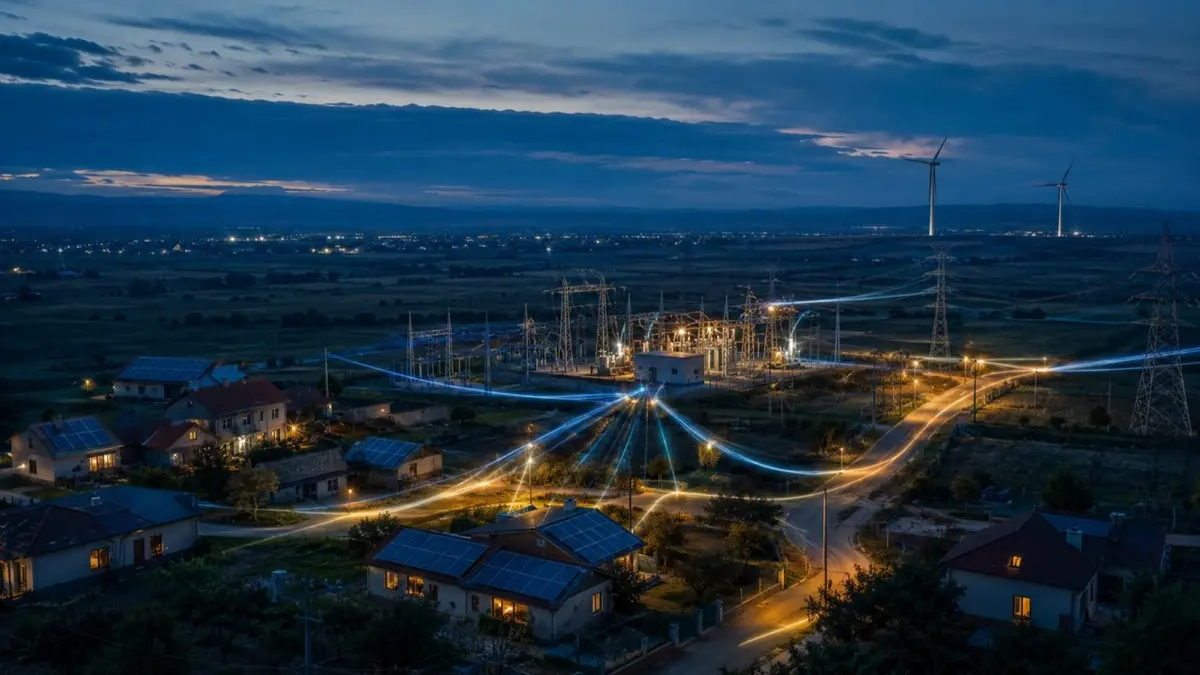
Solar panels produce direct current, which an inverter converts into alternating current synchronised with the grid. The electricity first supplies the building’s own consumption. Whatever is not used at that moment flows automatically into the grid, and in the evening or on cloudy days the site draws power from the grid like any other consumer.
The meter keeps the books. At the point of delimitation the distribution operator installs a two-way (bidirectional) meter that records electricity drawn from the grid and electricity fed into it separately. The distribution operator procures, installs, seals and reads the meters and sends the data to the supplier, which issues the invoices. The local distribution operator (Rețele Electrice România, Delgaz Grid, Distribuție Energie Oltenia or one of the DEER companies, for example) handles the connection, the certification of prosumer status and metering; the supplier handles the contract and the settlement.
Small plug-in systems below 800 W that connect to a wall socket are still generating installations: ANRE requires them to be fitted by authorised electricians or certified firms and the distribution operator to be informed, and prosumer status, optional in this case, can only be obtained through the dedicated prosumer connection procedure.
What happens to surplus power: quantitative compensation and financial regularisation
The mechanism depends on installed capacity per consumption site and changed in 2026. The rules of Law 123/2012 in force since 26 July 2026:
| Installed capacity per consumption site | What happens to the surplus | Settlement price |
|---|---|---|
| Up to 200 kW | Quantitative compensation, invoiced monthly, granted until 31 December 2030 | Active energy price in the supply contract, without tariffs and taxes |
| Households, up to 27 kW | Quantitative compensation, plus the right to use the resulting amount for the electricity bills of all their sites or for gas bills with the same supplier | Same price |
| Between 200 kW and 400 kW | Financial regularisation | Monthly weighted average day-ahead (PZU) price |
| Above 400 kW | The prosumer mechanisms do not apply; connection follows the general regulation (ANRE Order 59/2013) | Not applicable |
Up to 200 kW: quantitative compensation becomes monthly
Law 160/2026, published in Monitorul Oficial no. 603 on 23 July 2026 and in force since 26 July 2026, wrote a definition of quantitative compensation into the law. The supplier invoices three items every month: electricity drawn from the grid, at the price in the supply contract plus statutory tariffs and taxes; electricity fed into the grid up to the level of that consumption, at the active energy price without taxes and tariffs; and any excess exported in the same month, valued at the same price. The settlement price must exclude imbalance costs, the supply component, VAT, transmission and distribution tariffs, system services, the cogeneration contribution, green certificates and excise duty.
The most important change is the end of the kWh carry-over. Previously, unused surplus rolled into later bills and could be used for up to 24 months. According to ANRE, no new kWh carry-overs are created for electricity delivered from 26 July 2026, and both the compensated quantity and the surplus are invoiced monthly. Rights for electricity delivered up to and including 25 July 2026 remain subject to the rules in force at the time of delivery. The new definition also applies to contracts already running.
Under the law, quantitative compensation will be granted until 31 December 2030. After that, prosumers of up to 200 kW will sell on the terms that now apply between 200 kW and 400 kW, at the weighted average day-ahead market price.
Between 200 kW and 400 kW: financial regularisation at the PZU price
For installations between 200 kW and 400 kW per consumption site, the supplier must, at the prosumer’s request, buy the exported electricity at the weighted average price recorded on the day-ahead market (PZU) in the month of production and settle financially between the electricity delivered and the electricity consumed from the grid. The category is small but matters for businesses: at the end of 2025, 40 suppliers held 1,570 such contracts. In 2025 about 1,754 GWh was settled through the two mechanisms, 1,475 GWh through quantitative compensation and 278.5 GWh through financial regularisation.
What comes next: ANRE’s rules for Law 160/2026
The law gave ANRE 60 days to adapt the methodology approved by Order 15/2022. In August and September 2026 ANRE ran a two-phase public consultation on an order setting transitional measures for contracts already running and for those signed until 31 December 2026, and on a new methodology for trading, invoicing, settlement and multi-site value allocation, proposed to apply from 1 January 2027. In October 2026 both orders were still in the approval process, and points such as the payment deadline for surplus balances were still being discussed. Before any decision, check the final rules on ANRE’s prosumer page and the terms of your supply contract.
How to become a prosumer: the steps
ANRE sets out the following steps for a consumption site that needs a new connection solution:
- Submit a connection request to the distribution operator.
- The operator sets the connection solution and issues the technical connection permit (ATR).
- Sign the connection contract.
- Have the solar system, of up to 400 kW per consumption site, installed by qualified staff: ANRE-authorised electricians or ANRE-certified firms.
- Submit the installation file and the request to energise the installation for testing to the distribution operator.
- After testing, send the commissioning acceptance report.
- Receive the connection certificate and the certification of prosumer status from the distribution operator.
- Sign the contract with your electricity supplier for the sale of the electricity you feed into the grid.
If installing the panels does not require a change to the existing connection solution, the route is shorter: after installation you notify the distribution operator, which updates the connection certificate without issuing an ATR. The stages, deadlines and documents are set by the procedure approved by ANRE Order 19/2022.
The contract for exported electricity is signed with the supplier of the consumption site, not with the distribution operator. A Hidroelectrica customer signs the prosumer contract with Hidroelectrica, and a customer of any other supplier with that supplier: the obligation to take the surplus, on request, rests with the supplier that holds the prosumer’s supply contract. Network access rules for larger projects are covered on our grid connection page.
Prosumers and batteries
Batteries are the fastest-moving part of the segment. According to ANRE, the number of prosumers with storage rose from about 2,400 at the start of 2025 to 65,175 at the end of the year, then to 114,780 at 31 May 2026, a third of the total, and to 151,040 at 31 August 2026, almost 40% of all prosumers. More than 96% are households, which, ANRE notes, need electricity outside production hours, whereas companies’ consumption usually coincides with generation.
The economics follow from the billing rules. Electricity drawn from the grid is paid for with tariffs and taxes, while exported electricity is valued at the active energy price without them, so every kWh stored during the day and used in the evening replaces a kWh that would otherwise have been bought at the full price. ANRE’s technical rules require an additional meter on the storage system, and in 2024 the Casa Verde Fotovoltaice programme guide was extended to cover batteries of at least 5 kWh installed together with the panels. For grid-scale batteries, see our page on energy storage.
Romania’s prosumers in figures
| Date | Prosumers | Installed capacity | Prosumers with batteries |
|---|---|---|---|
| 31 December 2025 | 295,476 | 3,454 MW | 65,175 |
| 31 May 2026 | 346,194 | 3,897 MW | 114,780 |
| 31 August 2026 | 385,791 | 4,282 MW | 151,040 |
Source: ANRE, based on data reported by the distribution operators.
About 100,000 prosumers and roughly 1,075 MW were added in 2025, and another 90,315 prosumers and 828 MW in the first eight months of 2026, from just 303 prosumers at the end of 2019. The largest number are connected to the Rețele Electrice România network (102,040 at 31 August 2026). By county, Timiș, Arad, Bihor, Suceava, Iași, Argeș, Dolj and the Bucharest-Ilfov area were above the 10,000 mark at the end of 2025.
Exports follow the sun: in 2025 prosumers fed 1,770 GWh into the grid, peaking at 267 GWh in June and falling to 37 GWh in December. The wider picture is on our Romanian solar market page, and the investment case is set out in our analysis of prosumers as a distributed asset class.
What the prosumer boom means for the grid and the market
More than 4.2 GW of prosumer capacity generates in the same hours as the large solar parks. On 19 June 2026 total photovoltaic output, including prosumers, reached roughly 5 GW at midday, as we noted in our review of the solar market in the first half of the year. On sunny weekends midday supply exceeds demand and day-ahead prices clear below zero in some hours, a pattern discussed in our article on negative prices and batteries.
Three consequences matter for investors. First, self-consumption cuts demand on the grid precisely at midday, so new solar parks compete for the same hours with a distributed fleet that nobody dispatches. Second, for prosumers of up to 200 kW the settlement price comes from the supply contract, not from the hour of delivery, and the law bars imbalance costs from it, so the market value of midday power does not show up in what the prosumer receives. Third, storage ties the system together, from the home battery to the grid-scale one, and in PPAs and electricity prices the delivery profile, not just annual volume, carries more and more weight.
For businesses, the next stage runs through self-consumption at industrial scale, covered in our article on industrial self-consumption, and through energy communities, which ANRE regulated separately in 2026.
Momentum Energy’s view
As an EPC for utility-scale and commercial projects, we see prosumers as part of the same system rather than a parallel market. More than 4 GW of distributed generation, feeding in during the same hours as the solar parks, changes the price curve, the need for flexibility and the connection conditions for every new project.
That is why we believe storage and the production profile should be treated as part of the design of any new project, not as an option added later. The rules clarified by Law 160/2026 help companies considering self-consumption; for the rest of the market, the message is that Romanian middays will keep getting more crowded and value is shifting towards the evening hours. Our services page sets out what we do.
Frequently asked questions
What is a prosumer?
A prosumer is a final customer who generates renewable electricity at its own consumption site, mainly for its own use, and who may store that electricity and sell the surplus to the supplier it has a supply contract with. In Romania the definition sits in Article 3(95) of Law 123/2012, as amended by Law 160/2026.
Who can become a prosumer in Romania?
Any final customer that generates renewable electricity at its own consumption site: households, companies and public authorities and institutions. The mechanisms for selling surplus to the supplier apply to installations of up to 400 kW per consumption site, and for companies and institutions generating electricity must not be their main commercial or professional activity.
What is the maximum capacity for a prosumer?
The mechanisms for selling surplus to the supplier apply up to 400 kW per consumption site: quantitative compensation up to 200 kW and financial regularisation between 200 kW and 400 kW. Larger installations connect under ANRE's general connection regulation.
Who signs the prosumer contract for exported energy?
The electricity supplier of the consumption site, not the distribution operator. A Hidroelectrica customer signs with Hidroelectrica and a customer of any other supplier signs with that supplier. The distribution operator handles the connection, the connection certificate and the meter.
How much is a prosumer paid for electricity fed into the grid?
For systems up to 200 kW, exported energy is valued at the active energy price in the supply contract, without network tariffs and taxes. Between 200 kW and 400 kW, the supplier buys it at the monthly weighted average day-ahead market price. The actual value depends on each prosumer's contract.
What changed for prosumers in Romania in 2026?
Law 160/2026, in force since 26 July 2026, introduced monthly invoicing of quantitative compensation and of surplus energy with no new 24-month carry-over in kWh, clarified compensation across several sites and allowed households of up to 27 kW to use the resulting amount for gas bills with the same supplier. ANRE is finalising the implementing rules.
Do I need a battery to become a prosumer?
No. A battery is optional but increasingly common: at 31 August 2026, 151,040 prosumers, almost 40% of the total, had storage installed, according to ANRE.
What documents are needed to become a prosumer?
A connection request to the distribution operator, followed by the installation file, the request to energise the installation for testing and the commissioning acceptance report, prepared with an ANRE-authorised electrician or certified company. The exact list is set by the procedure approved by ANRE Order 19/2022.
Sources and references
Organisations and documents cited in this article.
- ANRE: Cum devin prosumator (steps, legislation and monthly prosumer statistics; page updated 14 October 2026)
- Law 160/2026 amending Electricity and Natural Gas Law 123/2012 (Monitorul Oficial no. 603, 23 July 2026), text as published, reproduced by Lege5
- ANRE: Prosumer situation at 31 August 2026
- ANRE: Prosumer situation at 31 May 2026
- ANRE: Report on monitoring prosumer activity in 2025 (2026)
- ANRE: Draft order on transitional measures for quantitative compensation, phase II consultation (21 September 2026)
- ANRE: Draft methodology on trading, invoicing, settlement and multi-site allocation for prosumers, phase II consultation (21 September 2026)
- ANRE: Minutes of the public debate on the two prosumer draft orders (25 September 2026)
- ANRE: Ghidul prosumatorului (prosumer guide, update of 23 March 2023)
- ANRE: Q&A on plug-in solar panels under 800 W (March 2026)
- ANRE (Romanian Energy Regulatory Authority)
- Hidroelectrica