Renewable Energy in Romania: Sources, Official Figures and Where It Is Heading
What renewable energy is, Romania's main sources and how much of its electricity comes from renewables: official 2024-2026 data, targets and green power.
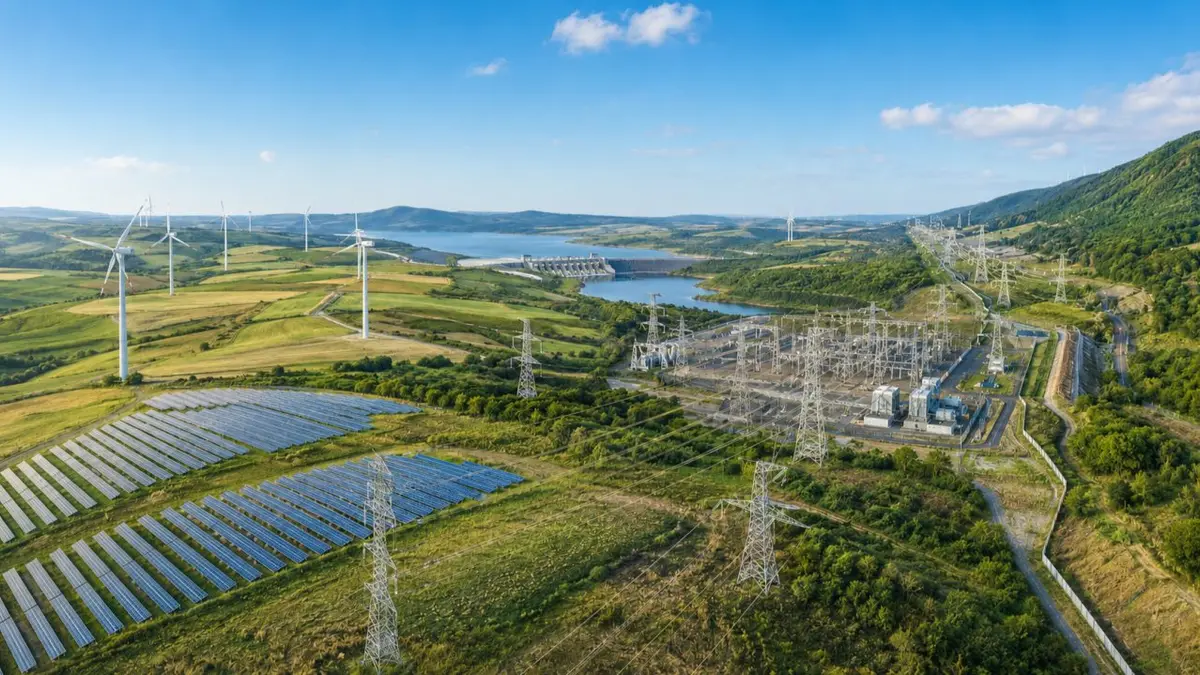
- Romania's main renewable energy sources are hydropower (6,688 MW installed at 1 January 2026), wind (3,136 MW) and solar (3,094 MW in licensed plants, plus 3,454 MW held by prosumers), according to Transelectrica.
- Renewables generated 50.0% of Romania's net electricity in 2024 and 48.9% in 2025; in January to July 2026 the share rose to 57.7%, with solar at 15.1%, according to Eurostat.
- Measured against all gross final energy consumption, including heating and transport, renewables covered 25.4% in 2024 (EU average 25.2%); the National Energy and Climate Plan targets 38.3% by 2030.
- Between 1 January and 21 August 2026, 2,514 MW of new capacity was connected to the grid, including 1,331 MW of solar, 663 MW of storage and 496 MW of wind.
- The Energy Strategy 2025-2035 targets about 24 GW of wind and solar capacity and a 58.5% renewable share of electricity consumption by 2035.
Renewable energy comes from sources that replenish naturally: sunlight, wind, water, biomass and heat from inside the earth. In Romania, renewable sources generated about half of the country’s electricity in 2024 and 2025, and in the first seven months of 2026 their share rose to 57.7%, according to Eurostat; measured against all energy use, including heating and transport, they covered 25.4% in 2024.
What renewable energy is
An energy source is renewable when it is replenished faster than it is consumed. Coal, natural gas and oil are fossil resources, and the uranium used at Cernavodă is finite too: nuclear power emits no CO2 in operation and is low-carbon, but it is not renewable. Heat pumps, which draw heat from the surrounding environment, are treated as a renewable technology in Romania’s official plans.
The difference between capacity and output also matters: installed capacity (MW) is what a plant can deliver at a given moment, while generation (MWh or TWh) is the energy it actually delivers over a year. In 2025 the 1,413 MW at Cernavodă produced 10.1 TWh net, more than twice the reported solar output (4.5 TWh), even though installed solar capacity was several times larger. The sun only shines by day, and the wind only blows some of the time.
Romania’s renewable energy sources
Hydropower, solar and wind supply almost all of Romania’s renewable electricity; biomass matters mainly for heating, and geothermal contributes almost nothing to power.
Hydropower, the largest renewable source
Hydropower plants had 6,688 MW installed at 1 January 2026, according to Transelectrica, the largest renewable capacity in the system. State-controlled Hidroelectrica, the country’s largest electricity producer, operates 188 hydropower plants with more than 6.3 GW. Output depends on rainfall and river flows, however: it fell from 14.0 TWh in 2024 to 12.1 TWh in 2025 (net generation, Eurostat), and 2025 was the driest year in Hidroelectrica’s history. For flexibility, Hidroelectrica approved a joint venture with EDF in January 2026 for the 1,000 MW Tarnița-Lăpuștești pumped-storage plant.
Solar energy, the fastest-growing source
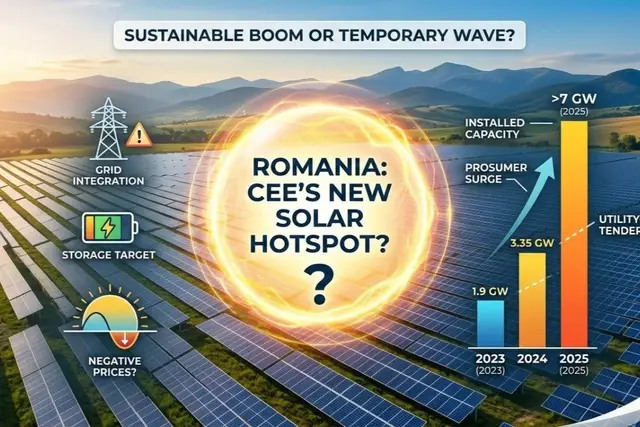
Romania installed about 2.2 GW of solar in 2025, and cumulative capacity passed 7 GW at the end of the year, roughly 3.5 GW of it in utility-scale plants. A further 1,331 MW of photovoltaic capacity was connected between 1 January and 21 August 2026.
The jump is even clearer in output: solar’s share of net electricity generation rose from 7.1% in 2024 to 9.7% in 2025 and 15.1% in January to July 2026. In the first seven months of 2026 solar plants generated 4.2 TWh, almost as much as in the whole of 2025 (4.5 TWh). How a utility-scale plant works is explained in our guide to solar parks in Romania, and the investor indicators are on our Romanian solar market page.
Wind: Dobrogea and the new CfD contracts
Wind farms had 3,136 MW installed at 1 January 2026, and roughly three quarters of dispatchable wind capacity sits in Dobrogea, in Constanța and Tulcea counties. Most of the fleet was built in 2010-2014; only about 330 MW was added in 2025, and a further 496 MW was connected in 2026 to 21 August. Three Contract for Difference (CfD) auction rounds have awarded more than 2.6 GW of onshore wind. In the Black Sea, Law 121/2024 created the framework for offshore wind, with a 3 GW target for 2035, but no concession tender had been launched at the time of writing. Wind generated 12.8% of net electricity in 2025. The details, including the largest wind farms, are in our wind farms and wind energy guide.
Biomass and biogas
In power generation, biomass plays a small role: biomass, biogas and other plants had 139 MW installed at 1 January 2026 and produced 0.5% of net electricity in 2025. Its large role is in heating, especially in rural areas. According to Romania’s National Energy and Climate Plan (NECP), biomass accounted for 56% of all the country’s renewable energy in 2022, and the plan expects that share to fall to 34% by 2030 as biomass stoves are replaced, mainly by heat pumps.
Geothermal energy
Romania has geothermal resources but uses them for heat, not electricity. At 1 January 2026 Transelectrica recorded a single geothermal unit of 0.05 MW, while the NECP cites about 150 MW of installed geothermal heating capacity used for district heating.
How much generating capacity Romania has
At 1 January 2026, power plants in Romania’s national power system (SEN) had 19,178 MW installed, according to Transelectrica. Renewable sources accounted for 13,057 MW, or 68% of the total.
| Source | Installed capacity (MW) | Share |
|---|---|---|
| Hydro | 6,688 | 34.9% |
| Wind | 3,136 | 16.4% |
| Solar (licensed plants) | 3,094 | 16.1% |
| Biomass, biogas and other | 139 | 0.7% |
| Geothermal | 0.05 | 0.0% |
| Nuclear | 1,413 | 7.4% |
| Hydrocarbons | 2,802 | 14.6% |
| Coal | 1,905 | 9.9% |
| Total SEN | 19,178 | 100% |
Source: Transelectrica, licensed installed capacity at 1 January 2026. Separately, the same document puts prosumer capacity at 3,454 MW and storage at 494 MW. The pv magazine estimate put total solar above 7 GW at the end of 2025; the counts differ in scope and date.
Nuclear means the two units at Cernavodă, about 700 MW each, which normally supply around a fifth of Romania’s electricity (21.7% in 2025). Unit 1 enters a 2027-2030 refurbishment backed by an EUR 800 million loan approved by the EIB. In summer 2026, very low Danube flows left the plant without cooling water and both units were shut down (on 28 July and 13 August), as our analysis of Romania’s month without nuclear power describes.
How much of Romania’s electricity comes from renewables
The answer depends on the indicator, and three different figures circulate, all of them correct:
- Share of electricity generation. Eurostat’s monthly data show renewables supplied 50.0% of net electricity generation in 2024, 48.9% in 2025 and 57.7% in January to July 2026.
- Share of electricity consumption under EU rules. For EU targets, Eurostat calculates the renewable share of gross electricity consumption (RES-E), with hydro and wind output normalised for dry or low-wind years: 47.6% for Romania in 2024, against an EU average of 47.5%.
- Share of all energy consumption. Including heating and transport, renewables covered 25.4% of gross final energy consumption in 2024, above the EU average of 25.2%. The figure is lower because transport ran on only 8.4% renewables and heating and cooling on 28.1%.
| Source | 2024 | 2025 | Jan-Jul 2026 |
|---|---|---|---|
| Hydro | 29.3% | 25.9% | 29.4% |
| Wind | 13.2% | 12.8% | 12.8% |
| Solar | 7.1% | 9.7% | 15.1% |
| Biomass and biogas | 0.4% | 0.5% | 0.4% |
| Total renewables | 50.0% | 48.9% | 57.7% |
| Nuclear | 21.0% | 21.7% | 17.6% |
| Natural gas | 17.4% | 17.3% | 15.6% |
| Coal | 11.6% | 12.1% | 9.1% |
| Total net generation | 47.8 TWh | 46.7 TWh | 27.9 TWh |
Source: Eurostat, net electricity generation by type of fuel, monthly data (nrg_cb_pem), extracted October 2026; recent months may be revised. Oil products (0.1% or less) are not shown.
The 2026 increase has three causes: newly connected solar, better hydro output than in the 2025 drought and less nuclear, after the planned outage of Cernavodă Unit 1 from 10 May to 4 July 2026. Electricity that prosumers generate and consume on site does not appear in reported production, so solar’s real contribution is larger than the table shows.
What is being built in 2026
Transelectrica connected 2,514 MW of new generation and storage capacity between 1 January and 21 August 2026: 1,331 MW of photovoltaic plants, 663 MW of storage, 496 MW of wind, 20 MW of hydrocarbon plants and 5 MW of biogas. The operator projects a further 1,000 MW or so of solar and wind and about 1,000 MW of storage by December 2026, a projection rather than a result. The investor indicators are on our Romanian energy market page.
- Battery storage reached 1,975 MWh (989 MW) on 1 August 2026, up from 1,130 MWh (599 MW) in April, according to Transelectrica; the revenue model is explained in our battery energy storage (BESS) guide.
- Prosumers numbered 385,791 at 31 August 2026, with 4,282 MW installed, and 151,040 of them had batteries, according to ANRE (Romanian Energy Regulatory Authority). The rules are in our prosumer guide.
- Contracts for Difference with 15-year terms were awarded for about 4.2 GW of solar and wind in the first two rounds (December 2024 and August 2025), plus about 316 MW of wind in round 3 (December 2025).
- Grid connection has become the main filter: from 2026, projects of 5 MW or more obtain capacity through Transelectrica auctions with a guarantee of EUR 20,000 per MW, and the first auction starts on 30 October 2026 (details in our grid connection and ATR guide).
- Delivery runs on a shared deadline: CfD projects must reach commercial operation within 36 months of signing, so most of the awarded capacity is due in 2028; the contractor’s role is described in our guide to EPC in solar.
Where it is heading: the Energy Strategy 2025-2035 and the NECP
The Energy Strategy 2025-2035, adopted in November 2024, targets about 24 GW of wind and solar capacity and a 58.5% renewable share of electricity consumption by 2035. The NECP, updated in October 2024, targets a 38.3% renewable share of gross final energy consumption and 57.8% of electricity by 2030; it plans 32.3 GW of installed capacity in 2030, about 75% of it renewable.
Set against the actual figures, the gap is clear. In electricity, Romania starts from 47.6% in 2024 and needs roughly ten more percentage points by 2030. For total energy, the road from 25.4% to 38.3% is much longer, and the NECP trajectory already assumed 31% in 2025. The European Commission had recommended at least 41%, a target the plan describes as challenging. The difference will be made in heating, through heat pumps, and in transport, through electrification.
What green energy means for consumers and producers
In everyday Romanian, “energie verde” (green energy) means electricity generated from renewable sources. A consumer can obtain it in two ways. The first is a contract with a supplier: the proof that a MWh comes from renewable sources is the guarantee of origin, explained in our renewable energy glossary. Guarantees issued in Romania can for now be used only domestically, and the country is aiming for full membership of the AIB, the association that runs the European system, from 1 January 2027. The second is self-generation, which turns the consumer into a prosumer.
For producers, “green” means access to support schemes and to buyers willing to pay for the origin of the power. The earlier support scheme was based on green certificates, and the 2013 cuts to it led to ICSID arbitration claims won against the state, a history that still feeds into the risk premium. New utility-scale projects sell their output through Contracts for Difference, through power purchase agreements (PPAs) with companies and on OPCOM’s day-ahead market (PZU), often combining these routes.
Why renewable energy matters for Romania
Energy security. Summer 2026 showed how weather-dependent the system’s base is: low Danube flows shut down Cernavodă, Romania declared a state of alert in the energy sector on 31 July, and on the evening of 11 August 2,151 MW of demand was met by imports. Domestic renewable generation reduces the need for imports, but mostly by day: Romania exports at midday, when solar output is high and prices are low, and imports at expensive peak hours, as our analysis of imports and the 52% renewable share shows. Hence the importance of storage.
EU funds. Romania received the largest amount of any beneficiary of the Modernisation Fund in 2024 and in the first cycle of 2026, and by September 2026 about EUR 7.41 billion had been approved for payment for Romanian investments. The fund finances the CfD scheme (EUR 3 billion) and the EUR 150 million call for standalone batteries, open from 1 September to 30 October 2026.
Prices. In CfD round 2, solar won an average strike price of EUR 40.46/MWh and wind EUR 73.8/MWh. On the PZU, the arithmetic average was EUR 108.16/MWh in 2025. Solar output is already pressing daytime prices down: from March to September 2026 peak hours (9-20) were cheaper than off-peak hours in every month, and in 23 of the 42 weeks OPCOM reported in 2026 at least one 15-minute interval cleared below zero.
Momentum Energy’s view
For us, the question is no longer whether Romania will have more renewable energy, but where and at what time of day it can be used. Midday solar output is growing faster than the system’s ability to shift it into the evening, so in our view the winners will be projects with guaranteed grid capacity, storage and an EPC that delivers on time.
We are the EPC contractor for a 79 MWp solar plant in Alba County, where works started on 1 October 2026, after building the 13.3 MWp Lunca Mureșului plant between 1 May and 5 September 2026. We hold ANRE certifications E1 (design), E2 (execution) and A3 (testing) under ANRE Order 134/2021. Our services cover market entry, project development, EPC, O&M and market intelligence.
Frequently asked questions
What is renewable energy?
Renewable energy comes from sources that replenish naturally: sunlight, wind, water, biomass and heat from inside the earth. Unlike coal, natural gas or uranium, these sources are not used up by being used.
What are Romania's renewable energy sources?
Hydropower (6,688 MW installed at 1 January 2026), wind (3,136 MW) and solar (3,094 MW in licensed plants, plus prosumer installations) produce almost all of the country's renewable electricity. Biomass matters mainly for heating, and geothermal resources are used for district heating rather than power.
What share of Romania's energy is renewable?
In 2024 renewables covered 25.4% of gross final energy consumption, including heating and transport, and 47.6% of electricity consumption as calculated under EU rules. In net electricity generation the share was 48.9% in 2025 and 57.7% in January to July 2026, according to Eurostat.
Is nuclear power renewable?
No. The Cernavodă plant emits no CO2 in operation and counts as a low-carbon source, but it runs on uranium, a finite resource. In 2025 nuclear supplied 21.7% of Romania's net electricity generation.
How much solar power does Romania produce?
Solar plants generated 4.5 TWh net in 2025, or 9.7% of the country's electricity, and 4.2 TWh in the first seven months of 2026 (15.1%), according to Eurostat. Cumulative solar capacity passed 7 GW at the end of 2025.
What does green energy mean in Romania?
In everyday use, green energy (energie verde) means electricity generated from renewable sources. Its renewable origin is proven by guarantees of origin, the certificates that underpin green PPAs and sustainability reporting.
What are Romania's renewable energy targets?
The National Energy and Climate Plan targets a 38.3% renewable share of gross final energy consumption and 57.8% of electricity by 2030. The Energy Strategy 2025-2035 aims for about 24 GW of wind and solar capacity and a 58.5% renewable share of electricity consumption by 2035.
Sources and references
Organisations and documents cited in this article.
- Transelectrica: Planificarea operațională a funcționării SEN în vara 2026, installed generation capacity at 1 January 2026
- Eurostat: Net electricity generation by type of fuel, monthly data (nrg_cb_pem), Romania, January 2024 to July 2026
- Eurostat: Share of energy from renewable sources (nrg_ind_ren), Romania and EU, 2024
- European Commission: Romania, final updated National Energy and Climate Plan 2021-2030 (October 2024)
- ANRE (Romanian Energy Regulatory Authority)
- Transelectrica (transmission system operator)
- OPCOM (Romanian power exchange)
- European Investment Bank (EIB)
- European Commission
- Eurostat
- Hidroelectrica
- EU Modernisation Fund (European Commission, Climate Action)