What Is a BESS? Battery Energy Storage Systems Explained for Projects in Romania
What a battery energy storage system (BESS) is, how MW, MWh and duration work, and how batteries earn money in Romania in 2026, including the grant rules.
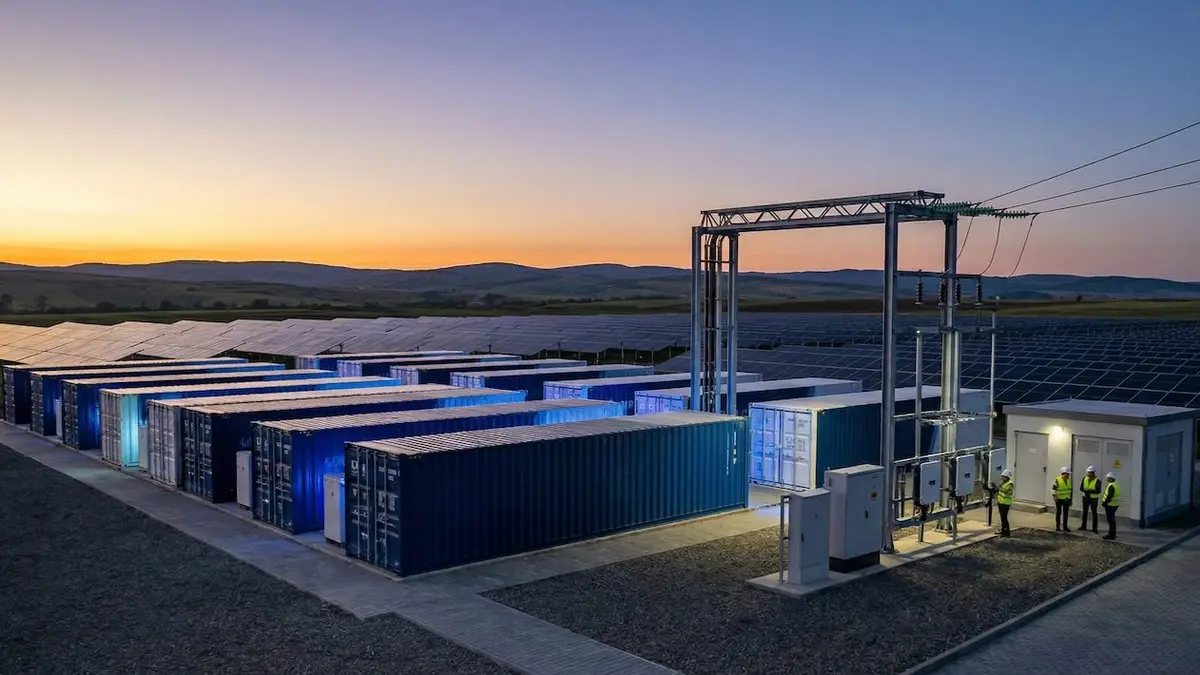
- A battery energy storage system (BESS) combines battery cells, a power conversion system, a transformer and an energy management system. Its power (MW) sets how fast it charges or discharges; its energy (MWh) sets for how long.
- In Romania, grid-scale batteries earn from balancing and ancillary services bought by Transelectrica and from arbitrage between cheap midday solar and the evening peak, often through an optimisation agreement with a trader.
- DNV estimated 2025 revenues for a two-hour battery in Romania at roughly EUR 120-180 per kW a year, but warns that FCR and aFRR prices may come under pressure as more batteries connect.
- Transelectrica data showed 1,975 MWh (989 MW) of battery storage in Romania on 1 August 2026, up from 1,130 MWh (599 MW) in April 2026.
- The EUR 150 million Modernisation Fund call for standalone batteries (1 September to 30 October 2026) caps aid at EUR 69,000 per MWh and EUR 15 million per company; the CfD scheme does not reward storage.
A battery energy storage system (BESS) stores electricity in battery cells and returns it to the grid when it is worth more, under the control of power electronics and software. In Romania, grid-scale and commercial batteries earn money from balancing services bought by the transmission system operator Transelectrica and from trading the gap between cheap midday solar and the evening peak. This guide explains how a BESS works, how it is sized and paid, and what investors should check before committing to a project.
What is a battery energy storage system (BESS)?
A BESS charges when electricity is plentiful and cheap, holds the energy for a few hours and discharges it when the system needs it. It produces nothing of its own: its value comes from timing and speed, since a battery can swing from charging to discharging in seconds. Grid operators use that speed to keep frequency stable; traders use it to buy low and sell high within the same day.
This guide covers grid-scale and commercial systems: standalone batteries on the transmission or distribution network, batteries next to solar and wind parks, and larger units at industrial sites. Household batteries use similar cells but form a different market; by the end of May 2026, 114,780 Romanian prosumers, a third of the total, had battery storage.
Main components: cells, PCS, transformer and EMS
A utility-scale BESS has four main building blocks:
- Battery cells, modules and racks, housed in containers with cooling and fire protection. A battery management system (BMS) monitors the voltage, temperature and state of charge of every cell.
- Power conversion system (PCS), the inverters that turn the battery’s direct current into the alternating current used by the grid, and back again when charging.
- Transformers and a substation, which raise the voltage to the level of the connection point: medium voltage for smaller systems, 110 kV or more for large ones.
- Energy management system (EMS) and SCADA, the software that decides when to charge, when to discharge and which market to sell into, and that receives dispatch signals from the grid operator.
The Iaz battery in Caraș-Severin County shows the scale. Its 98.6 MW / 196.4 MWh system, built for a GÜRİŞ company by the Romanian EPC Simtel, uses 44 lithium-ion battery containers, 528 inverters, 11 transformer stations, a dedicated 110 kV substation and an EMS.
MW vs MWh: power, capacity and duration
Two numbers describe every battery. Power, in megawatts (MW), is how fast it can charge or discharge. Energy capacity, in megawatt-hours (MWh), is how much electricity it can hold. Dividing the second by the first gives the duration: the 127 MW / 254 MWh Scornicești battery in Olt County delivers its full power for two hours.
Duration decides what a battery can sell. Short systems suit frequency services and the sharpest part of the evening peak; longer ones capture more of the daily price spread but cost more per MW. Romania’s fleet is short: the 1,130 MWh and 599 MW counted by Transelectrica in April 2026 work out at a little under two hours on average. The 2026 Modernisation Fund call requires at least two hours, a 2:1 ratio between MWh and MW.
Two more terms appear in every offer and model:
- Round-trip efficiency: part of the energy is lost between charging and discharging; for lithium-ion the loss is roughly 10-15% per cycle.
- Degradation: capacity falls with cycling and age, so supply contracts set a warranted cycle budget and often provide for augmentation, adding modules later to keep the contracted MWh.
Lithium-ion vs sodium-ion batteries
Lithium-ion dominates the Romanian market; lithium iron phosphate (LFP) is the variant generally used for stationary storage.
Sodium-ion is the first credible alternative at scale. In April 2026 Renalfa Power Clusters announced a 3.6 GWh dual-chemistry cluster in Arad County that combines lithium-ion and sodium-ion batteries with solar, the largest commercial sodium-ion deployment planned in the EU (our analysis). Sodium-ion cells keep more capacity in the cold (85-90% at minus 20°C, against 60-70% for typical lithium-ion) and need no lithium, cobalt or nickel, but their energy density is lower and their field record shorter. That is why Renalfa pairs the two chemistries.
Batteries solve hours, not days. For overnight flexibility Romania is looking at pumped hydro: in January 2026 Hidroelectrica approved a joint venture with EDF to develop the 1,000 MW Tarnița-Lăpuștești plant, with no investment decision yet.
Standalone, co-located and hybrid storage
A standalone battery has its own grid connection and meter and trades on its own account. The applicant guide for the 2026 Modernisation Fund call defines it precisely: a dedicated technical connection permit (ATR), its own connection to the grid at any voltage, dedicated metering, no integration with a generation or consumption site and no direct line to a generator or consumer.
A co-located battery shares a site, and usually the connection, with a solar or wind park. It shifts solar output into the evening, reduces curtailment and lifts the plant’s capture price, the average price the plant actually earns. The EBRD’s EUR 120 million loan in 2026 for a 342 MW solar plus 300 MWh battery project shows that lenders finance this design. A hybrid plant is designed and dispatched as one unit, like Enery’s Ogrezeni project in Giurgiu County, which combines 534 MW AC of solar with more than 1 GWh of storage.
One rule shapes every co-located design: the Contracts for Difference scheme was written for generation and does not reward storage. Energy that passes through a battery loses its CfD settlement, so developers meter the battery separately and give it its own revenue model, as we explained in our analysis of the CfD and storage.
How a BESS makes money in Romania
A battery earns from several markets, often on the same day. The combination, known as the revenue stack, changes as more batteries come online.
Balancing and ancillary services
Transelectrica buys reserves that keep the grid’s frequency stable: frequency containment reserve (FCR), the fastest, and automatic and manual frequency restoration reserves (aFRR and mFRR). A battery must pass Transelectrica’s technical qualification before offering them. DNV put 2025 FCR prices at around EUR 70 per MW per hour and aFRR at close to EUR 9 per MW per hour in each direction, but demand is shallow: roughly 80-130 MW for FCR and 165-200 MW for aFRR. With 989 MW of batteries installed by 1 August 2026, those pools are filling, and DNV names pressure on FCR and aFRR prices as a key risk.
Day-ahead and intraday arbitrage and negative prices
Arbitrage means charging when power is cheap and discharging when it is expensive, on the OPCOM day-ahead market (PZU) and the intraday market. Romania’s daily price curve is unusually steep: DNV measured an average day-ahead price of EUR 110/MWh in 2025 and a maximum daily price spread of EUR 168/MWh. On one trading day in 2026 prices fell to EUR 1/MWh in the afternoon and reached EUR 199.10/MWh in the evening.
Midday solar now pushes some hours below zero. After commercial solar output hit a record 2,048 MW in March 2026, the day-ahead market recorded its first negative intervals of 2026. For a battery, a negative hour means being paid to charge (our analysis of negative prices). Adding wholesale trading and ancillary services, DNV estimated 2025 revenues for a two-hour battery at roughly EUR 120-180 per kW a year, with a central figure of about EUR 140.
Optimisation agreements and network tariffs
Many owners sign an optimisation agreement with a trader or aggregator who bids the battery across the day-ahead, intraday and balancing markets, and lenders now expect one. The EBRD’s June 2026 financing of Scornicești, up to EUR 44 million, rests on mainly merchant revenues under an optimisation agreement with GEN-I, with EUR 29 million covered by an InvestEU first-loss guarantee (how the deal works).
Network charges were the other barrier. Under Order 56/2025 of ANRE (Romanian Energy Regulatory Authority), in force since 10 July 2025, electricity drawn from the grid, stored and fed back is exempt from the transmission extraction tariff, the system services tariff and distribution tariffs, until ANRE sets a dedicated tariff system for storage.
Battery storage in Romania: where the market stands
Transelectrica data showed 1,975 MWh and 989 MW on 1 August 2026, and 663 MW of storage was connected between 1 January and 21 August 2026. The operator projects about 1,000 MW more by December 2026, ANRE counts a pipeline of 9,147 MW in 143 projects, and Transelectrica estimates that integrating planned renewables will require 10-20 GWh of storage by 2030. Our battery storage market page tracks these figures with dates and sources.
Selected projects covered in our analyses:
| Project (owner) | County | Power / energy | Type | Status |
|---|---|---|---|---|
| Florești (Nova Power & Gas) | Cluj | 201 MW / 402 MWh | Standalone | Operating since December 2025 |
| Gura Ialomiței (Aukera) | Ialomița | 150 MW / 300 MWh, first phase of 250 MW / 500 MWh | Standalone | First phase completed June 2026 |
| Scornicești (R.Power, Eiffel) | Olt | 127 MW / 254 MWh | Standalone | EBRD financing, June 2026 |
| Iaz (Energy Capital Group, GÜRİŞ) | Caraș-Severin | 98.6 MW / 196.4 MWh | Standalone | Completed May 2026 |
| Near Iași (Premier Energy) | Iași | 200 MW / 400 MWh | Standalone | Construction since May 2026 |
| Ogrezeni (Enery) | Giurgiu | 534 MW AC solar, over 1 GWh storage | Hybrid | Financing closed March 2026 |
| Arad cluster (Renalfa) | Arad | 400 MW / 800 MWh plus 365 MWp solar, planned 3.6 GWh | Hybrid, two chemistries | Launch targeted for 2027 |
The 2026 Modernisation Fund call for standalone batteries
The Ministry of Energy’s EUR 150 million call, financed from the Modernisation Fund, accepts applications on the MySMIS platform from 1 September to 30 October 2026. The main terms of the applicant guide:
- Target: at least 2,174 MWh of new capacity, roughly what EUR 150 million buys at the ceiling.
- Aid: up to EUR 69,000 per MWh installed and up to 100% of eligible costs, capped at EUR 15 million per company however many projects it files.
- Ranking: by the lowest state aid requested per MWh, which makes the grant a reverse auction.
- Applicants: companies of any size, including newly established ones with at least RON 100,000 of paid-up capital, whose articles cover CAEN division 35; no partnerships.
- Technical: at least 1 MW per installation and two hours of duration; the ATR must be in place by the first payment request.
- Deadline: commissioning within 48 months of signing the financing contract, proven by the connection certificate.
A provisional ranking is expected in November 2026. Bid sizing is the hard part: a low aid request improves the ranking but leaves more of the cost to equity and debt, as we set out in our analysis of the call.
Investor checklist for a BESS project in Romania
- Grid position first. Check the ATR, the connection point and local congestion; capacity allocation requires a guarantee of EUR 20,000 per MW under ANRE Order 15/2026 (see our grid connection page).
- Size duration to the revenue stack. Decide MW, MWh and cycles per day together, and meet the 2:1 minimum if you will seek a grant.
- Model compression. Stress-test balancing revenues against a pipeline of more than 9 GW; 2025 FCR prices are not a base case.
- Secure a route to market. Agree the optimisation agreement (fees, revenue share, any floor) before financial close.
- Match warranties to dispatch. Align the cell warranty, cycle budget, augmentation plan and EMS logic.
- Fix the CfD perimeter. Next to a CfD plant, meter the battery separately and keep stored energy outside CfD settlement.
- Price currency risk. Revenues are earned in lei while most equipment and debt are in euros, a risk DNV also flags.
- One party for integration and O&M. Make one contractor responsible for the PCS, EMS and SCADA interface, and define availability for the whole site.
Momentum Energy’s view
Batteries are the fastest-moving part of Romania’s power market, and the gap between good and weak projects will widen as the fleet grows and balancing prices fall. In our view the decisive choices are made before procurement: the grid node, the duration, the optimisation partner and the warranty terms. A grant improves the entry case; it does not repair a project in the wrong place.
We hold ANRE certifications for design (E1), execution (E2) and testing (A3), and we support investors from project sourcing and development through EPC and O&M. We judge every battery business case on its revenue stack after compression, not on the prices of 2025. Our services page explains how we work.
Frequently asked questions
What is a BESS?
A battery energy storage system: battery cells in containers, a power conversion system that converts between direct and alternating current, transformers that connect it to the grid and an energy management system that decides when to charge and discharge. It absorbs electricity at one time and returns it later.
What is the difference between MW and MWh in a battery?
MW is the power, how fast the battery can charge or discharge. MWh is the energy it can hold. Dividing MWh by MW gives the duration: a 127 MW / 254 MWh battery can discharge at full power for two hours.
How do batteries make money in Romania?
From balancing and ancillary services procured by Transelectrica (FCR, aFRR and mFRR), from arbitrage on the day-ahead and intraday markets, and through optimisation agreements with traders who run the battery across these markets. A co-located battery also raises the value of a solar park's output.
How much battery storage does Romania have?
Transelectrica counted 1,130 MWh with 599 MW of power in April 2026 and 1,975 MWh with 989 MW on 1 August 2026. Between 1 January and 21 August 2026, 663 MW of new storage was connected to the grid.
Is there a grant for battery storage in Romania?
The Ministry of Energy's EUR 150 million Modernisation Fund call for standalone batteries accepts applications from 1 September to 30 October 2026. Aid is capped at EUR 69,000 per MWh and EUR 15 million per company, projects need at least 1 MW and two hours of duration, and applications are ranked by the lowest aid requested per MWh.
Is a home battery a BESS?
It uses similar technology but belongs to a different market: a household battery stores rooftop solar for the home's own use, while the systems in this guide are grid-scale or commercial assets that trade in electricity markets. At the end of May 2026, 114,780 Romanian prosumers had a battery.
Sources and references
Organisations and documents cited in this article.
- DNV: Why Romania is emerging as a prime battery storage market in Europe (16 February 2026)
- EBRD: EBRD backs large-scale battery storage project in Romania (4 June 2026)
- ANRE Order 56/2025 on exempting stored electricity from regulated network tariffs (Monitorul Oficial 649/10.07.2025)
- Ministry of Energy: applicant guide for standalone battery storage, annex to Order 915/14.08.2026 (copy published by StartupCafe)
- Economica.net: Transelectrica storage data for 1 August 2026 and the largest batteries in Romania (4 August 2026)
- ANRE (Romanian Energy Regulatory Authority)
- Transelectrica (transmission system operator)
- Romanian Ministry of Energy
- OPCOM (Romanian power exchange)
- European Bank for Reconstruction and Development (EBRD)
- Hidroelectrica
- EU Modernisation Fund (European Commission, Climate Action)