
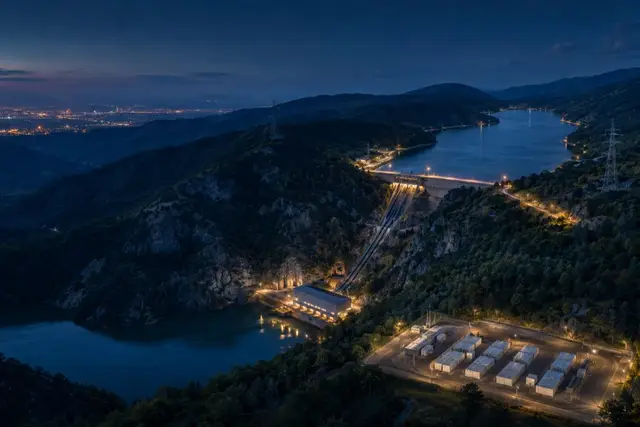
Batteries Solve Hours. Tarnița Could Solve Romania’s Overnight Flexibility Problem.
Batteries cover a few hours of Romania's evening peak. Overnight needs something else. Tarnița is 1,000 MW.

From pilot to bankable in two years: capacity, revenue and the EUR 150 million Modernisation Fund call.
In shortRomania had 1,130 MWh (599 MW) of operational battery storage by April 2026 and connected a further 663 MW of storage between January and 21 August 2026. The EBRD financed the 127 MW / 254 MWh Scornicești standalone battery on a largely merchant model and lent EUR 120 million to a 342 MW solar plus 300 MWh project. A EUR 150 million Modernisation Fund call for standalone batteries runs from 1 September to 30 October 2026 with aid capped at EUR 69,000 per MWh.
Capacity connected to the Romanian grid in 2026, by technology
MW, 1 January to 21 August 2026
| Item | MW |
|---|---|
| Photovoltaic | 1,331 |
| Storage | 663 |
| Wind | 496 |
| Hydrocarbons | 20 |
| Biogas | 5 |
By April 2026 Transelectrica counted 1,130 MWh of operational storage with 599 MW of delivery power, and 663 MW of storage was among the 2,514 MW connected in 2026 to 21 August, including the 76.76 MW / 150.288 MWh IS Părău facility that pushed the annual total past 2,500 MW. The operator projects around 1,000 MW of additional storage by December 2026. At the small end, 114,780 prosumers had batteries at the end of May 2026, a third of all prosumers.
Standalone batteries earn from balancing and ancillary services procured by Transelectrica, from arbitrage between midday solar surpluses and evening scarcity on the day-ahead and intraday markets, and, where structured, from optimisation agreements with traders. The Scornicești project financed by the EBRD in 2026 relies on mainly merchant revenues through an optimisation agreement, backed by an InvestEU first-loss guarantee, which is the template lenders are now using. Co-located storage improves the capture price of solar and is increasingly treated as the bankability standard for new hybrid projects.
One design gap matters: the CfD scheme was written for generation and does not reward storage, so developers combining a CfD-backed plant with a battery need a separate revenue model for the storage asset.
In July 2026 the Ministry of Energy allocated EUR 250 million from the Modernisation Fund to storage and smart meters. The EUR 150 million standalone battery call opened on 1 September 2026 and closes on 30 October 2026: at least 2,174 MWh of new capacity is targeted, projects are ranked by the lowest state aid requested per MWh, aid is capped at EUR 69,000 per MWh and EUR 15 million per company, and applicants must operate under CAEN code 35. Earlier storage support came through the Recovery and Resilience Plan and previous Modernisation Fund calls for co-located batteries.
Lithium-ion dominates, and sodium-ion has arrived at scale according to our June 2026 analysis of a 3.6 GWh supply agreement. The system need is structural: Cernavodă Unit 1 enters a 2027-2030 refurbishment, hydro output depends on Danube flows that fell to their lowest level since 1996 in summer 2026, and midday solar is pushing prices below zero. Batteries solve hours; longer-duration options such as the Tarnița pumped-storage project remain under discussion for overnight flexibility.
Storage is the segment where Romania's numbers have moved fastest and where we expect the widest gap between the best and worst projects. Grants help, but the durable advantage will belong to owners with good grid positions and credible optimisation partners. We would rather back a well-sited 100 MWh battery with a merchant model we understand than a larger project whose economics depend on a grant that may not be awarded.
The view above is Momentum Energy's opinion and is separated from the sourced facts in the tables. It is not investment advice.
1,130 MWh with 599 MW of delivery power were operational by April 2026 according to Transelectrica, and 663 MW of storage was connected between January and 21 August 2026.
Yes. A EUR 150 million Modernisation Fund call for standalone batteries is open from 1 September to 30 October 2026, with aid capped at EUR 69,000 per MWh and EUR 15 million per company and a target of at least 2,174 MWh.
The EBRD financed the 127 MW / 254 MWh Scornicești standalone battery in 2026 with mainly merchant revenues under an optimisation agreement, supported by an InvestEU first-loss guarantee, which shows that it can be done with the right structure.
No. The CfD contracts cover solar and wind generation. Storage assets co-located with a CfD plant need their own revenue model.
Batteries cover a few hours of Romania's evening peak. Overnight needs something else. Tarnița is 1,000 MW.
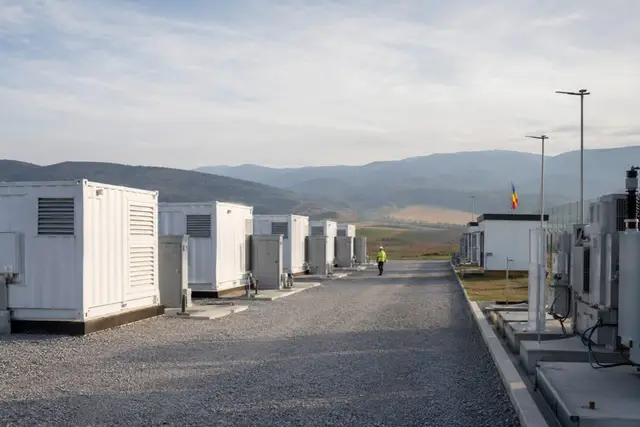
Romania's EUR 150 million battery storage call ranks purely on requested aid per MWh, capped at EUR 69,000.
Romania just passed a milestone that would have looked improbable two years ago.