What Is EPC in Solar? How EPC Contracts Work in Romania and How to Choose a Contractor
EPC means engineering, procurement and construction. What a solar or storage EPC contract covers, ANRE certifications and choosing a contractor in Romania.
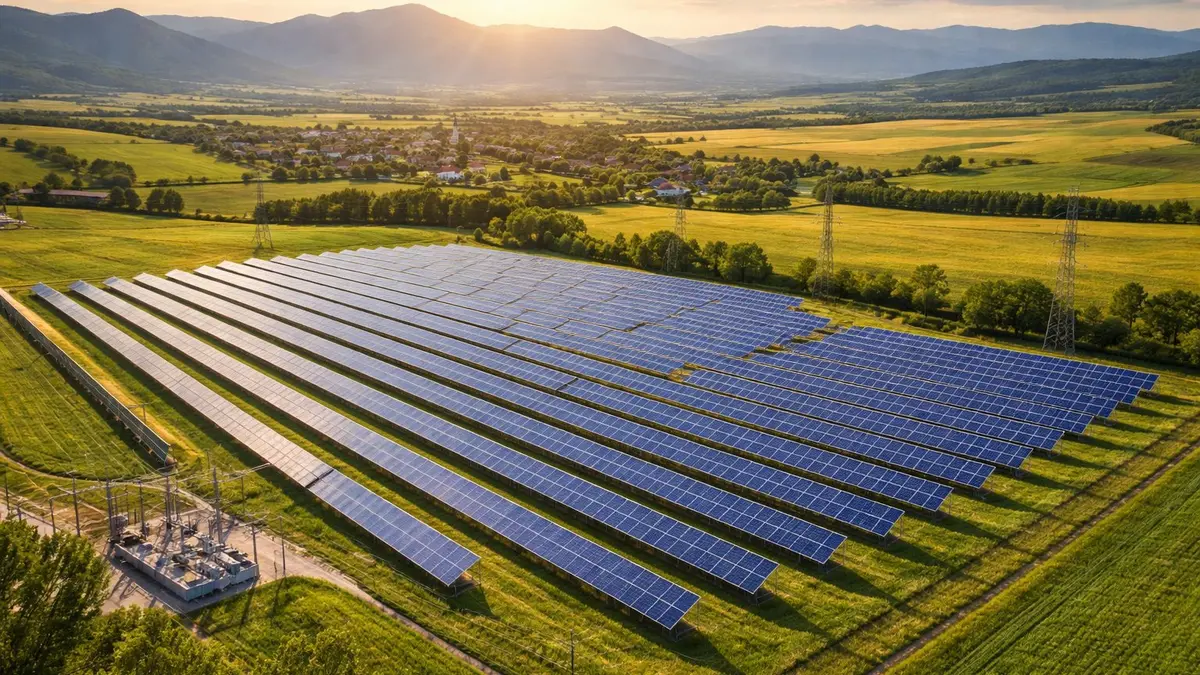
- EPC stands for engineering, procurement and construction: one contractor designs the plant, buys the equipment, builds it and hands it over tested and ready to operate.
- A turnkey EPC contract gives the owner one lump-sum price, one completion date and one party responsible; separate contracts can cost less but leave the interfaces with the owner.
- In Romania, the design, execution and verification of electrical installations must be carried out by operators certified by ANRE under Order 134/2021; for power plants and substations the relevant types are E1, E2 and A3.
- The second CfD round required a target commissioning date no later than 36 months after the anticipated contract signature and a performance guarantee of EUR 75,000 per MW, and most awarded capacity faces a 2028 deadline.
- EPC ends when the plant is accepted; operations and maintenance (O&M) then take over, and work on the electrical side remains subject to ANRE's certification rules.
EPC stands for engineering, procurement and construction: a contract model in which a single company designs a power plant, buys the equipment and builds it, then hands it to the owner tested and ready to operate. In renewable energy, the EPC contract usually covers everything from the technical design of a solar park or battery to energisation, including the grid connection works. The term has nothing to do with the energy performance certificate for buildings, which is also abbreviated EPC.
What EPC means in renewable energy
The three letters describe three stages that depend closely on one another in a renewable project:
- Engineering (E): the design of the plant, from the layout of the panel rows and the structural calculations to the electrical design, the transformer substation and the connection solution set out in the technical connection permit (ATR).
- Procurement (P): the purchase of equipment and materials: modules, inverters, mounting structures, cables, transformers, medium-voltage switchgear and, for storage, the battery containers.
- Construction (C): the site works, installation, cabling and the substation, followed by testing and commissioning.
The value of the model lies in single-point responsibility. If the inverters do not match the electrical design or a delivery is late, the owner does not have to arbitrate between designer, supplier and builder: the EPC contractor, which took on the whole, is answerable. The developer remains the owner: it secures the land, the permits and the grid capacity, then contracts the construction. The market context is set out on our page on solar energy in Romania.
What an EPC contract covers for a solar or storage plant
The scope is negotiated, but a full EPC contract for a utility-scale plant typically includes the elements below; the last column shows what to check before signing.
| Element | What it covers | What to check |
|---|---|---|
| Engineering | basic and detailed design, layout, electrical design, transformer substation, connection solution | who signs the electrical design and under which ANRE certification |
| Procurement | modules, inverters, structures, cables, transformers, medium-voltage switchgear, batteries and the power conversion system | named suppliers, manufacturers’ warranties, delivery schedule tied to the commissioning date |
| Construction | site set-up, roads and fencing, foundations, installation, cabling, the substation | works schedule, subcontractors, the technical execution manager (responsabil tehnic cu execuția) |
| Testing and commissioning | equipment tests, the compliance tests required for energisation, performance tests | who carries out the tests (A3 certification) and the contract’s acceptance criteria |
| Grid connection | the works set out in the ATR and the connection contract, coordination with Transelectrica or the distribution operator | who is liable if the grid operator is late |
| Monitoring and control | SCADA, the energy management system (EMS) for batteries, integration with the grid operator’s systems | compatibility with the grid operator’s requirements |
For battery storage the scope widens: the containers, the power conversion system and the control software become part of the EPC. A public example from Alba County is Eurowind Energy’s battery at Teiuș, whose EPC contract, worth more than EUR 16.6 million, covered the entire chain according to Energynomics: design, procurement, construction, installation, integration into the SCADA, DMS and EMS systems, testing and authorisation for commercial operation.
Procurement also faces a new condition: the European Commission has classified solar inverters as a cybersecurity-relevant asset for EU-funded projects, so the inverter supplier has to be checked against the project’s sources of finance (see our analysis of inverters and EU funding).
Turnkey EPC or separate contracts
In practice, owners choose between two structures.
Turnkey EPC at a lump-sum price. One company takes on design, procurement and construction for a fixed price and a fixed completion date. The interface risk, meaning what happens when one component does not fit another, sits with the contractor, which prices it in. The international reference for this model is FIDIC’s Conditions of Contract for EPC/Turnkey Projects, known as the Silver Book, whose second edition was published in 2017. FIDIC itself does not recommend it where tenderers lack the time or information to check the employer’s requirements, or where the employer intends to supervise the works closely.
Separate contracts. The owner buys modules and inverters directly, then contracts the civil works, the electrical works and the substation separately. It can obtain better prices and more control over the equipment, but it takes on the interfaces: a supplier’s delay or a technical mismatch becomes the owner’s problem, not the builder’s. The structure requires an in-house project management team and, for financing, a closer look at execution risk.
An intermediate option is an EPC contract in which the owner supplies the modules and the contractor takes on the rest. Whatever the structure, the allocation of risk has to be written into the contract explicitly, not inferred.
What an EPC contract contains: guarantees, damages, acceptance
The clauses below appear, in some form, in most EPC contracts for renewable plants. The values (percentages, caps, durations) are negotiated project by project; there is no “standard” figure that holds without analysis.
Performance guarantees
The contractor guarantees that the plant performs as promised. For solar, the guarantee is usually expressed through the performance ratio (PR) or the installed capacity, verified by a test after commissioning; for batteries, through usable capacity, efficiency and availability. If the plant fails the test, the contract provides for remedies or compensation. Separately, the manufacturers’ warranties for modules, inverters and batteries need to be transferred to the owner at handover.
Delay damages and bank guarantees
For each day of delay beyond the completion date, the contractor pays damages fixed in advance, usually capped. Their level matters: if the owner itself faces deadlines (a CfD, a PPA or a loan), the EPC delay damages should cover at least part of its loss. The contractor’s obligations are usually secured by bank guarantees: a performance guarantee and, where there is an advance payment, an advance payment guarantee.
Acceptance of the works and the warranty period
In Romania, the acceptance of construction works follows the regulation in the form set by Government Decision (HG) 343/2017 and takes place in two stages: acceptance at completion of the works, and final acceptance at the end of the warranty period. According to the State Construction Inspectorate, a construction may be put into use only after the investor admits acceptance at completion, and the warranty period cannot be shorter than the legal minimum under Law 10/1995, which depends on the construction’s importance category. The EPC contract lays its own stages over this framework: mechanical completion, commissioning, performance tests and the remedying of defects that appear during the warranty period.
ANRE certifications E1, E2 and A3 and why they matter
ANRE (Romanian Energy Regulatory Authority) sets who may design, execute and verify electrical installations. The regulation approved by ANRE Order 134/2021, in force since 1 January 2022, provides that these activities are carried out by economic operators holding certifications issued by ANRE, within the competences of each certification type. For a utility-scale solar park or battery, three types matter directly:
- E1: design of transformer stations, substations and installations belonging to the electrical part of power plants, at any standardised nominal voltage;
- E2: execution of the same works;
- A3: testing of electrical equipment and installations for the certification of a plant’s technical compliance with the applicable technical norms.
The rule has direct consequences for the contract. A general contractor without an ANRE certification may subcontract the electrical works only to certified operators and only with the owner’s consent, and it remains jointly liable with the subcontractor for those works. Companies from the EU, the EEA or Switzerland can work in Romania once ANRE confirms their right to provide cross-border services, on the basis of the equivalent document from their home country. Companies from other countries, Türkiye included, can obtain an ANRE certification if they meet the regulation’s conditions and have a secondary office registered in Romania. ANRE publishes the list of certifications in force, suspended and withdrawn on its website, so the check can be made before signing.
The 2028 CfD deadline and EPC capacity
Romania’s Contracts for Difference scheme awarded 4.2 GW of solar and wind in its first two rounds. For round two, the auction rules required the target commissioning date to be no later than 36 months after the anticipated signature of the CfD contract, and winners post a performance guarantee equivalent to EUR 75,000 per MW installed. As a result, most of the awarded capacity faces a 2028 deadline.
For EPC, the consequence is demand concentrated in a narrow window: the same contractors, the same long-lead equipment, transformers above all, and the same grid connection capacity, allocated by Transelectrica by area since 2026 against a participation guarantee of EUR 20,000 per MW under ANRE Order 15/2026. Lenders have publicly called for a larger pool of EPC contractors with international experience, brought in at the design stage, and contractors in the market report that the paperwork for energisation can hold up plants that are technically complete. We covered these risks in our analyses of EPC capacity and the CfD scheme and of the 36-month clock.
The practical conclusion: a CfD award brings revenue certainty, not delivery certainty. The EPC contract, the equipment schedule and the connection status need to be assessed separately, and the EPC delay damages sized with the CfD performance guarantee in mind.
How to choose an EPC contractor in Romania
Before signing, check at least the following:
- ANRE certifications that match the work: E1 for the design of the electrical part and the substation, E2 for execution, A3 for compliance testing, held by the company that actually does the work and confirmed on the list ANRE publishes.
- Completed plants, not just megawatts under construction: references for projects of comparable size and technology (solar, batteries, hybrid) that have reached energisation.
- Experience with the relevant grid operator: connecting to Transelectrica differs from connecting to a distribution operator; ask who prepares the documentation and tests for energisation.
- The procurement plan: named suppliers, their warranties, delivery dates tied to the commissioning date and the eligibility of the inverters for EU funding.
- Real capacity in 2027-2028: how many projects the contractor runs in parallel and how many site teams and authorised electricians it can assign to yours.
- Financial strength: the ability to issue the bank guarantees required and to fund procurement until payment.
- Contract terms: lump-sum price, fixed date, delay damages and performance guarantees sized against your own obligations (CfD, PPA, loan), and clear liability caps.
- Connection risk: who is liable if the grid operator delays the works or energisation.
- Continuity after handover: who takes over operations and maintenance, and how the warranties and the construction’s technical file are transferred.
When buying a ready-to-build project, the list becomes part of the technical due diligence (see also our analysis of solar projects that stay on paper).
EPC vs O&M: where construction ends and operation begins
EPC ends with the handover of the plant, after acceptance and testing. Operations and maintenance (O&M) begin there: monitoring, preventive and corrective maintenance, spare parts, performance reporting and warranty management, for the whole operating life. An O&M contract is measured differently from a construction contract: by plant availability, response times and output against the business plan.
ANRE’s rules matter here too. Order 134/2021 counts maintenance work that requires intervention on components of electrical installations as execution work, and certification holders may contract the operation of producers’ electrical installations, meaning supervision, switching operations and maintenance, within the competences of their certification. Producers licensed by ANRE may carry out such work on the networks they operate with their own qualified and authorised staff, without a certification.
Combining EPC and O&M with the same partner has a clear advantage: whoever built the plant knows it best, and defects that appear during the warranty period are resolved without disputes between builder and operator. Precisely because quality control then stays in the same hands, it is worth having acceptance and performance tests followed by an independent engineer acting for the owner or the lender.
Momentum Energy’s view
We work as an EPC contractor in Romania. We completed the 13.3 MWp solar plant at Lunca Mureșului, in Alba County, with works starting on 1 May and finishing on 5 September 2026, and on 1 October 2026 we started works on a 79 MWp plant, also in Alba County. We hold ANRE certifications E1, E2 and A3, and our technical team has completed more than 30 solar plants. On that experience, our advice is to start the EPC conversation before financial close, not after: the electrical design, the transformer schedule and the energisation paperwork decide whether a 2028 deadline is realistic.
We do not think one structure fits every project. For an investor new to the market, a turnkey contract with a locally certified partner reduces the number of interfaces; a developer with its own team may choose separate contracts. Either way, the EPC contract should be read together with the ATR, the CfD or PPA and the loan. Engineering, procurement, construction and operation are described on our services page.
Frequently asked questions
What does EPC mean in solar?
EPC stands for engineering, procurement and construction. It is the contract under which one company designs a solar or storage plant, buys the equipment and builds the plant through to commissioning.
What is a turnkey EPC contract?
A contract in which the EPC contractor takes on the whole construction for a lump-sum price and a fixed completion date and hands the owner a tested plant ready to operate. The risk that parts of the project do not fit together stays with the contractor.
Which ANRE certifications does a solar EPC contractor need in Romania?
For the electrical part of a power plant and its substation, the relevant certifications under ANRE Order 134/2021 are E1 (design), E2 (execution) and A3 (testing for the certification of the plant's technical compliance). Smaller, lower-voltage works can fall under other certification types.
Can a foreign EPC contractor work in Romania?
Yes. Companies from the EU, the EEA or Switzerland need an ANRE decision confirming their right to provide cross-border services. Companies from other countries, for example Türkiye, can obtain an ANRE certification if they meet the regulation's conditions and have a secondary office registered in Romania.
What is the difference between EPC and O&M?
EPC covers design, equipment procurement and construction up to the handover of the plant. O&M, operations and maintenance, starts after handover and covers monitoring, preventive and corrective maintenance, spare parts and performance reporting over the plant's operating life.
How long does it take to build a solar park in Romania?
It depends on the size of the plant, the grid connection works and equipment delivery times. As a reference, the 13.3 MWp plant at Lunca Mureșului in Alba County, where Momentum Energy was the EPC contractor, was built between 1 May and 5 September 2026. CfD winners must reach commercial operation within 36 months of contract signature.
Sources and references
Organisations and documents cited in this article.
- ANRE Order 134/2021 approving the Regulation for the certification of economic operators that design, execute and verify electrical installations (Official Gazette no. 1216, 22 December 2021)
- Ministry of Energy Order 427/2025, Annex 1: rules of the second CfD auction (published by OPCOM)
- State Construction Inspectorate (ISC): acceptance of construction works under HG 343/2017
- FIDIC: Conditions of Contract for EPC/Turnkey Projects (Silver Book), second edition 2017
- Energynomics: Eurowind Energy Teiuș storage project enters the installation phase (5 March 2026)
- ANRE (Romanian Energy Regulatory Authority)
- Transelectrica (transmission system operator)
- European Commission