Romanian Renewable Energy Glossary: 32 Market Terms Explained, From ANRE and the ATR to Prosumers and the PZU
What do prosumer, CfD, PZU, EPC, BESS and ATR mean in Romania? 32 renewable energy market terms explained plainly, with official 2026 figures.
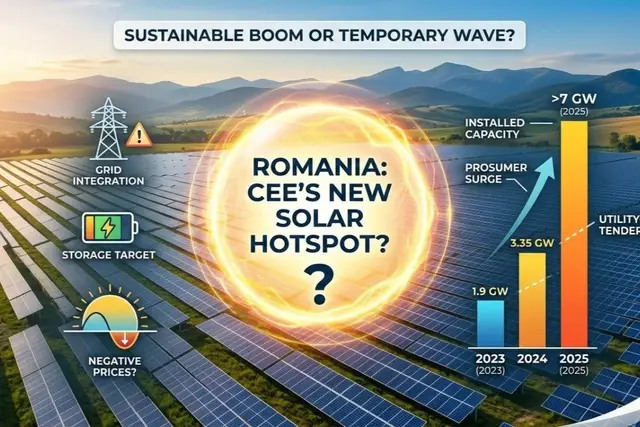
- A prosumer is a final customer who generates renewable electricity for their own consumption and can store it and sell the surplus; Romania had 346,194 prosumers with 3,897 MW installed on 31 May 2026 (ANRE).
- Grid connection runs through a technical connection permit (ATR), a connection contract and a connection certificate; since 21 May 2026, capacity requests require a EUR 20,000/MW guarantee (ANRE Order 15/2026).
- The PZU is the day-ahead market run by OPCOM; it averaged EUR 150.51/MWh in January 2026 and EUR 122.99/MWh in June 2026.
- A CfD is a two-way, 15-year contract; Romania's three rounds have awarded more than 4.5 GW of solar and wind, with OPCOM as counterparty.
- ANRE regulates the market, Transelectrica is the transmission and system operator, OPCOM runs the spot markets and the Ministry of Energy organises CfD auctions and Modernisation Fund calls.
This glossary defines 32 terms that anyone developing, financing or buying renewable power in Romania will meet, from ANRE (Romanian Energy Regulatory Authority) and the ATR to prosumers and the PZU. Each definition explains how the concept works in the Romanian market, with dated figures, and links to the analysis that covers it.
Who does what in the Romanian energy market
| Institution | Role | For projects |
|---|---|---|
| ANRE | Regulator: orders, methodologies, authorisations, licences | Sets grid connection rules and guarantees |
| Transelectrica | Transmission and system operator; balancing market | Connects large projects, allocates grid capacity by zone |
| Distribution operators | 110 kV, medium and low voltage networks | Connect smaller projects and prosumers |
| OPCOM | PZU, intraday market, centralised markets | Reference price; CfD counterparty |
| Ministry of Energy | CfD auctions, Modernisation Fund calls | Timetable of public support |
A-B
Ancillary services
Ancillary services (servicii de sistem) are the reserves Transelectrica procures to keep frequency stable and the system secure: FCR (frequency containment reserve), aFRR and mFRR (automatic and manual frequency restoration reserves). Batteries stack them with arbitrage on the day-ahead and intraday markets, under rules described on our energy storage page.
ANRE
ANRE (Romanian Energy Regulatory Authority) regulates the energy sector: it approves grid connection methodologies, grants establishment authorisations and licences, publishes prosumer data and certifies companies that design and build electrical installations. The most closely watched act of 2026 is ANRE Order 15/2026, on the guarantee for grid capacity.
ATR (technical connection permit)
The aviz tehnic de racordare (ATR) is issued by Transelectrica or the distribution operator and sets the connection point, the approved capacity and the works required; it is the first formal step of grid connection. On 1 April 2026 around 1,500 projects held ATRs for more than 86 GW, although the system needs roughly 9,000 MW. For new projects of 5 MW or more, the ATR comes only after the allocated capacity has been paid for.
Balancing market
On the balancing market, Transelectrica buys or sells energy to offset, in real time, deviations of generation and consumption from scheduled values. Participants’ deviations are settled as imbalances, while batteries and other flexible units earn by offering balancing energy, which is why this market shapes energy storage revenues.
BESS (battery energy storage system)
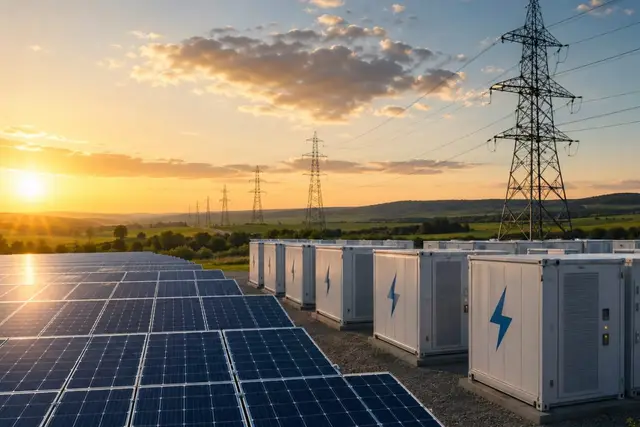
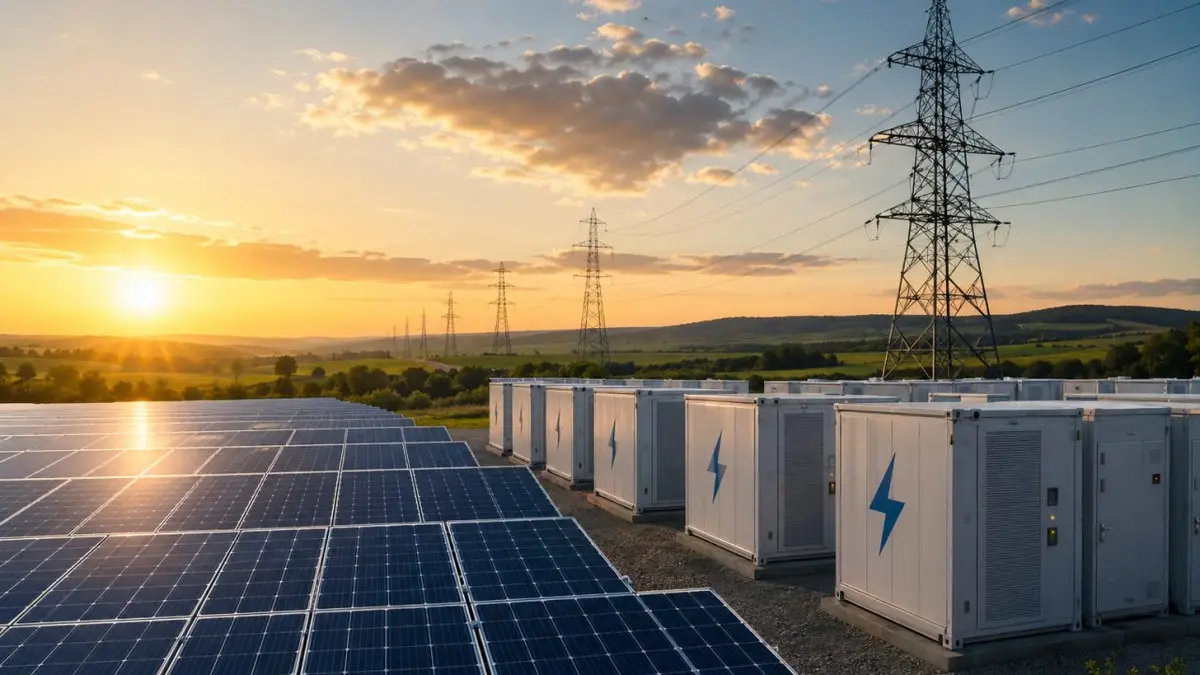
A BESS stores electricity in batteries, either standalone or co-located with a solar or wind plant. Romania had 1,130 MWh (599 MW) of battery storage in operation in April 2026, and a further 663 MW was connected by 21 August. The Modernisation Fund has a EUR 150 million call for standalone batteries, with a 30 October 2026 deadline.
C
Capacity auction
The capacity auction is the procedure through which Transelectrica awards grid capacity to generation and storage projects of 5 MW or more, under the ANRE methodology (Order 53/2024, amended by Orders 79/2025 and 15/2026). The first auction holds daily sessions from 30 October 2026, and the capacity won covers 2028-2037, as our analysis of the first auction explains.
Capture price
The capture price is the average price a plant actually earns, weighted by its output profile. For solar it falls as more panels generate in the same midday hours, while wind, which also produces in the evening, holds its value better, as our analysis of the third CfD auction shows. Co-located storage raises the capture price of a solar plant.
CfD (Contract for Difference)
A Contract for Difference is a two-way, 15-year contract: the generator receives the difference when the market price is below the strike price and pays it back when the market is above. The scheme, financed with EUR 3 billion from the Modernisation Fund, is run by the Ministry of Energy, with OPCOM as counterparty; three rounds have awarded more than 4.5 GW. Winners have 36 months from signing to reach commercial operation.
Connection certificate (certificat de racordare)
The connection certificate is issued by the grid operator once the works are complete and confirms that the installation may operate; it is the last step of grid connection, after the ATR and the connection contract. For prosumers, according to ANRE, the distribution operator issues the connection certificate together with the prosumer certification.
Connection contract (contract de racordare)
The connection contract is signed with the grid operator after the ATR, as the second step of grid connection; under it the applicant pays the connection fee and the works are built. Since 2026, if the establishment authorisation is not obtained on time, the ATR and the contract terminate automatically and the guarantees are called.
Curtailment
Curtailment is the reduction of a renewable plant’s output because the grid cannot absorb all the available power, owing to congestion or surplus supply. In Romania it occurs mainly at midday in areas with heavy solar generation and goes hand in hand with negative prices, as our article on curtailment explains.
D-H
Day-ahead market (PZU)
The PZU (piața pentru ziua următoare) is the OPCOM market where electricity is traded for the following day; its clearing price is the short-term reference for the Romanian market. Coupled with European markets, it averaged EUR 150.51/MWh in January 2026, EUR 109.56/MWh in May and EUR 122.99/MWh in June, figures tracked on our PPA and electricity prices page.
Distribution operator (DSO)
Distribution operators run the regional 110 kV, medium and low voltage networks and connect consumers, prosumers and smaller projects. Projects between 5 and 50 MW file their requests for grid capacity through the distribution operator, and for prosumers it issues the ATR and the connection certificate and meters the power, according to ANRE.
EPC (engineering, procurement and construction)
EPC is the model in which a single company is responsible for design, equipment procurement and construction through to commissioning. The 36-month deadline in the CfD scheme concentrates EPC demand around 2028, a delivery risk covered in our analysis of EPC capacity. Momentum Energy is delivering EPC for a 79 MWp solar plant in Alba County, where works started on 1 October 2026.
Establishment authorisation (autorizație de înființare)
The establishment authorisation is the ANRE act that allows a new generation or storage plant to be built; commercial operation then requires a licence. Since 2026 it must be obtained within 12 months of the connection contract, otherwise the ATR and the contract terminate automatically, as our analysis of the capacity auction explains. In February 2026 ANRE suspended an authorisation for the first time, for three months, for a wind project whose holder could not prove its financing.
Greenfield project
A greenfield project starts from scratch, on a site with no permits, grid connection or infrastructure. Since 2026, in the Romanian energy market, the entry condition is grid capacity: the EUR 20,000/MW guarantee and zonal allocation come before the ATR.
Guarantees of origin (GO)
Guarantees of origin are certificates proving that a MWh was produced from renewable sources; they underpin green PPAs and corporate sustainability reporting. Issued in a national registry, Romanian GOs can for now be used only in Romania; the country targets full membership of the AIB, the association that runs the European certificate system, from 1 January 2027, as our analysis of guarantees of origin explains. GOs are not green certificates, the support scheme for older plants explained in our green certificates guide.
Hybrid project
A hybrid project combines two or more technologies, usually solar with wind or solar with batteries, often behind the same grid connection. In August 2026 the EBRD lent EUR 120 million to a project combining 342 MW of solar with 300 MWh of batteries, and lenders increasingly treat hybrid designs as the bankability standard, as our analysis of hybrid projects shows.
I-O
Intraday market
The intraday market, run by OPCOM and coupled with European markets through SIDC, allows trading after the PZU closes, close to delivery. Solar generators correct their forecasts here, and batteries capture price differences within the day, as our PPA and electricity prices page shows.
Modernisation Fund
The Modernisation Fund is financed by auctioning EU ETS allowances and supports energy investment in 13 member states over 2021-2030. Romania received the largest payments of any beneficiary in 2024 and in the first 2026 cycle, and by September 2026 about EUR 7.4 billion had been approved for payment for Romanian investments; the fund pays for the CfD scheme and the EUR 150 million call for standalone batteries. Our Modernisation Fund guide lists the calls.
MW, MWh and MWp
MW measures power and MWh energy: a 127 MW / 254 MWh battery can deliver its full output for about two hours. MWp is the peak power of solar modules under standard test conditions and can differ from the capacity approved at the grid connection. Momentum Energy’s plants are stated in MWp, while solar market figures keep the unit of their source.
Negative prices
Negative prices occur when supply exceeds demand and export capacity and the PZU clearing price drops below zero. In Romania they appear on sunny, low-demand weekends and hit the midday market revenues of solar plants hardest, while for batteries they are an opportunity, as our analysis of negative prices shows.
O&M (operation and maintenance)
O&M covers the running of a plant after commissioning: production monitoring and preventive and corrective maintenance. A plant’s availability translates directly into revenue over the life of a CfD or PPA. Momentum Energy offers O&M services alongside EPC and project development.
OPCOM
OPCOM, a subsidiary of Transelectrica, is Romania’s electricity market operator: it runs the PZU, the intraday market and centralised contract and green certificate markets, but not the balancing market. As CfD counterparty, it signed 75 contracts in 2025, for 2,630.48 MW of wind and 1,914.34 MW of solar.
P-Z
PNRR (National Recovery and Resilience Plan)
Romania’s PNRR (Planul Național de Redresare și Reziliență) ended at around EUR 20.1 billion after its final revision, with milestones due by 31 August 2026 and payments closing on 31 December 2026. In energy, the 3.5 GW CfD target was exceeded with 4,544.82 MW contracted, according to our analysis of the end of the PNRR.
PPA (physical and virtual)
A PPA (power purchase agreement) fixes, over the long term, the price at which a generator sells power to a buyer. In a physical PPA the electricity is actually delivered to the buyer; in a virtual PPA the generator sells on the market and the parties settle the difference against the agreed price, with the buyer usually receiving the guarantees of origin. Rezolv Energy signed a 10-year virtual PPA with Bekaert for 100 GWh of wind power a year; more on our PPA and electricity prices page and in our guide to PPAs in Romania.
Prosumer
A prosumer (prosumator) is a final customer who generates electricity from renewable sources for their own consumption and can store it and sell the surplus to the grid, usually with rooftop solar panels. According to ANRE, Romania had 346,194 prosumers with 3,897 MW installed on 31 May 2026, and 33% of them had batteries. Connection and certification go through the distribution operator; more in our article on prosumers.
Ready-to-build (RTB)
A ready-to-build project has every precondition for construction in place: land rights, a grid connection with confirmed capacity, a building permit, environmental approval and an establishment authorisation. In the Romanian energy market, many international investors buy projects at this stage, and the 2026 rules have made them scarcer and more valuable.
Strike price
The strike price is the fixed price won in a CfD auction, against which difference payments are calculated. In round 2 (August 2025) solar averaged EUR 40.46/MWh and wind EUR 73.8/MWh. Under the rules of the CfD scheme, the price is indexed only once every three years, and only if cumulative inflation exceeds 10%.
Superficies right (drept de superficie)
A superficies right lets a developer build and own a plant on land that belongs to someone else. Large projects are usually built on agricultural land outside built-up areas, whose sale follows the pre-emption procedure under Law 17/2014, or on land held through superficies; the rules are summarised on our solar page.
TSO (transmission system operator): Transelectrica
Transelectrica runs the high-voltage transmission network and national dispatch, allocates interconnection capacity and administers the balancing market. Since 2026 it has allocated grid capacity by zone, under the procedure explained in our analysis of capacity allocation. Between 1 January and 21 August 2026 it reported 2,514 MW of new capacity connected.
Zonal capacity allocation
Since June 2026 Transelectrica has allocated grid capacity by zone, through competitive procedures rather than in order of application. Where demand does not exceed capacity, the auction price is zero; where it does, bids are ranked by price. For grid connection, location has become part of the bid.
Momentum Energy’s view
In the Romanian market the same terms mean different things to a developer, a lender and a power buyer, and the confusion is costly. An ATR does not guarantee a plant, a CfD does not guarantee delivery on time, and a MWp is not a MW at the connection point.
When we assess a project, we read these terms in the order in which they decide value: grid connection and allocated capacity first, then permits and the EPC contract, then revenues. We will update the definitions as the rules change.
Frequently asked questions
What is a prosumer in Romania?
A final customer who generates electricity from renewable sources, usually with solar panels, for their own consumption and can store it and sell the surplus to the grid. According to ANRE, Romania had 346,194 prosumers with 3,897 MW installed on 31 May 2026.
What is the PZU?
The PZU is Romania's day-ahead market, run by OPCOM, where electricity is traded for the following day. Its price is the market's short-term reference; the monthly average was EUR 109.56/MWh in May 2026.
What is a CfD in the energy market?
A 15-year Contract for Difference awarded by the Ministry of Energy through auctions: the generator receives the difference when the market price is below the strike price and pays it back when the market is above. OPCOM is the counterparty.
What is an ATR (aviz tehnic de racordare)?
The technical connection permit issued by Transelectrica or the distribution operator, which sets the connection point, the approved capacity and the works required. It is the first formal step of grid connection, followed by the connection contract and the connection certificate.
What is a connection certificate (certificat de racordare)?
The document issued by the grid operator once the works are complete, confirming that the installation is connected and may operate. For prosumers it is issued by the distribution operator, together with the prosumer certification.
What does EPC mean?
EPC (engineering, procurement and construction) is the model in which a single company is responsible for design, equipment procurement and construction of a plant through to commissioning.
What is a BESS?
A battery energy storage system. Romania had 1,130 MWh (599 MW) of battery storage in operation in April 2026, according to Transelectrica.
Sources and references
Organisations and documents cited in this article.
- OPCOM, Raport anual OPCOM S.A. 2025
- Transelectrica, Functions
- Transelectrica, Structura pieței angro de energie electrică din România
- ANRE, Cum devin prosumator
- ANRE, Comunicat de presă: 850 de megawați înființați într-o singură ședință a Comitetului de reglementare (18.02.2026)
- ANRE (Romanian Energy Regulatory Authority)
- Transelectrica (transmission system operator)
- Romanian Ministry of Energy
- OPCOM (Romanian power exchange)
- European Bank for Reconstruction and Development (EBRD)
- EU Modernisation Fund (European Commission, Climate Action)