Wind Farms in Romania: How They Work, the Largest Projects, CfDs and Offshore Wind
What a wind farm is, how a turbine makes electricity, where Romania's wind farms are, the largest projects, CfD prices and the Black Sea offshore plan.
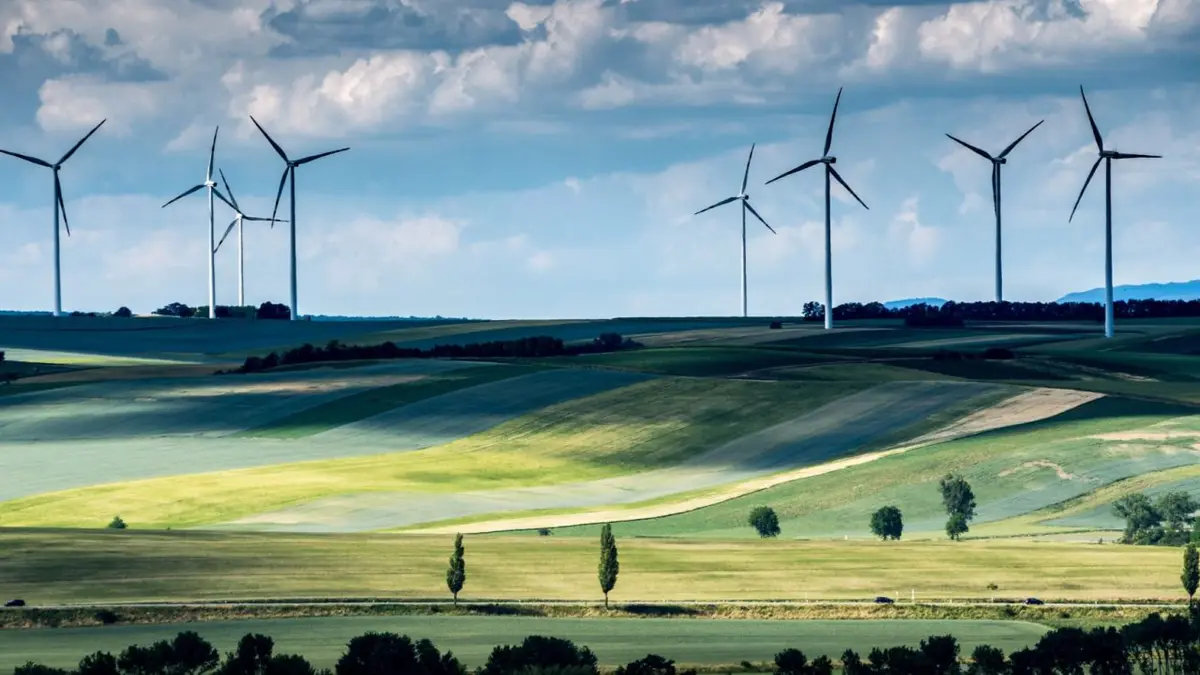
- A wind farm is a power plant made up of several wind turbines connected to the grid through a shared substation; its size is measured in installed MW and its output in MWh per year.
- Romania's wind farms had 3,136 MW of installed capacity on 1 January 2026, according to Transelectrica, and a further 496 MW of wind was connected between 1 January and 21 August 2026.
- Roughly three quarters of Romania's dispatchable wind capacity is in Dobrogea (Constanța and Tulcea counties).
- Romania's largest wind farm is Fântânele-Cogealac in Constanța County: 600 MW from 240 turbines, completed in 2012. VIFOR in Buzău will reach 461 MW when its second phase is finished in 2027.
- Three CfD rounds have awarded more than 2.6 GW of onshore wind at strike prices of EUR 54.49 to 79.5/MWh; offshore, Phase 1 comprises three Black Sea perimeters totalling 3.1 GW, with no tender launched at the time of writing.
A wind farm is a power plant made up of several wind turbines that convert the energy of the wind into electricity and feed it into the grid through a shared substation. On 1 January 2026 Romania had 3,136 MW of wind capacity, most of it in Dobrogea, and the country’s largest wind farm is still Fântânele-Cogealac, a 600 MW plant in Constanța County. After a decade of stagnation, Contracts for Difference auctions have awarded more than 2.6 GW of new wind since December 2024, and the Black Sea now has a legal framework and a 3.1 GW first offshore phase.
What is a wind farm, and what is wind energy?
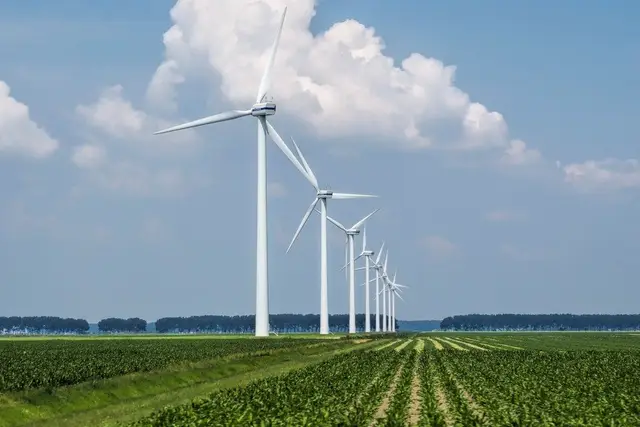
Wind energy is the kinetic energy of moving air. A wind turbine captures it with its blades and turns it into electricity. A wind farm, called a wind power plant in technical documents, groups several turbines on one site, linked by underground cables. For the grid operator a wind farm is usually a single plant with one technical connection permit (ATR).
The size of a wind farm is expressed in megawatts (MW) of installed capacity, the sum of the turbines’ rated output. Annual generation, in MWh or GWh, depends on the wind, because turbines do not run at full power all the time. The Green Breeze wind farm in Galați County has 99.2 MW and announced output of about 312 GWh a year, roughly 3,150 MWh per installed megawatt (our calculation, based on the owner’s figures).
How does a wind turbine generate electricity?
Wind flowing over the blades creates lift, as it does on an aircraft wing, which turns the rotor (the blades and the hub). The rotor drives a shaft connected to a generator, either directly in “direct drive” turbines or through a gearbox that raises the rotation speed. The generator sits in the nacelle, the housing on top of the tower, and converts rotation into electricity.
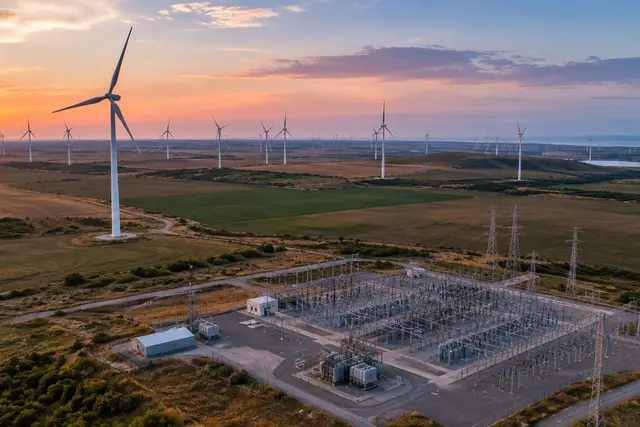
An anemometer measures the wind, and the controller starts the turbine at about 3 to 5 m/s and shuts it down for protection above roughly 25 m/s. The pitch system changes the angle of the blades to control rotor speed, and the yaw system turns the nacelle to face the wind. Because wind is stronger higher up, taller towers capture more energy. From the turbines, power flows through cables to the wind farm’s substation, where transformers raise the voltage to the 110 kV or 400 kV grid.
The gap between turbine generations is wide. Romania’s wind farms built between 2010 and 2014 mostly use 2 to 3 MW turbines with blades of 45 to 50 metres. The turbines going up now are rated at 6 to 7 MW with rotors of 158 to 175 metres: Green Breeze uses 16 Vestas V162-6.2 MW machines, and VIFOR’s first phase has 30 Vestas V162 turbines of 6.4 MW each.
Onshore and offshore wind farms: the differences
| Onshore wind (on land) | Offshore wind (at sea) | |
|---|---|---|
| Status in Romania | 3,136 MW installed on 1 January 2026 | no wind farm built; perimeters approved in August 2026 |
| Where | Dobrogea, then Moldova, the Bărăgan plain and Banat | Romania’s sector of the Black Sea |
| Technology | 6 to 7 MW turbines on new projects | fixed foundations in 55 to 75 m of water in Phase 1 |
| Revenue | 15-year CfD, power purchase agreements (PPAs), market sales | support scheme not yet published |
| Timeline | most CfD projects target 2028 | first offshore megawatt expected around 2032 |
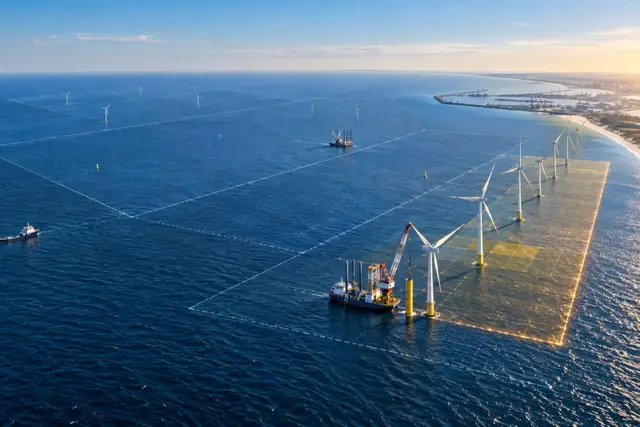
An offshore wind farm needs ports, installation vessels, subsea cables and an onshore grid able to absorb its output. Romania has never built one, and the port and vessel infrastructure required does not yet exist, so every wind farm under construction in the country today is onshore.
Romania’s wind farms: how much capacity, and where?
According to Transelectrica, the wind farms in Romania’s national power system had 3,136 MW of installed capacity on 1 January 2026. Most of it was built between 2010 and 2014; the market then stalled, and only about 330 MW was added in 2025. In 2026, between 1 January and 21 August, 496 MW of new wind capacity was connected, out of 2,514 MW of new generation and storage in total.
The geography is highly concentrated. In its summer 2026 study, Transelectrica modelled 2,982 MW of net available capacity at dispatchable wind farms, of which 2,262 MW sits in the Dobrogea zone, roughly three quarters. The other zones are Băltăgești-Gura Ialomiței (250 MW), Moldova including Buzău (240 MW), Lacu Sărat-Smârdan (159 MW) and Banat (71 MW). Dobrogea (Constanța and Tulcea counties) has the best wind resource and also the most congested grid. We keep the market figures up to date on our page on wind energy in Romania.
The largest wind farms in Romania
Romania’s largest wind farm is Fântânele-Cogealac in Constanța County: 240 turbines and 600 MW in total. CEZ completed it in November 2012 and presented it at the time as Europe’s largest onshore wind farm. CEZ later sold its Romanian assets to a fund managed by Macquarie, and in November 2024 Greece’s PPC completed the acquisition of the portfolio, which includes about 600 MW of operating onshore wind.
The largest new project is VIFOR. Rezolv Energy energised its 192 MW first phase in Buzău County in October 2026; according to the company, it is the largest wind project energised in Romania in more than a decade. The 269 MW second phase follows in 2027 and will take the wind farm to 461 MW.
| Wind farm | County | Capacity | Owner | Status (October 2026) |
|---|---|---|---|---|
| Fântânele-Cogealac | Constanța | 600 MW (240 turbines) | PPC (built by CEZ) | operating since 2012 |
| VIFOR | Buzău | 192 MW; 461 MW after phase 2 | Rezolv Energy | phase 1 energised (October 2026), phase 2 in 2027 |
| Gura Văii, Podu Turcului and Poiana (three wind farms) | Bacău and Galați | 305 MW in total | OMV Petrom and RNV Infrastructure | investment decision (April 2026); first output targeted in H1 2027 |
| Gurbănești | Călărași | 252 MW (42 GE Vernova turbines) | Greenvolt | turbines ordered, deliveries from 2026 |
| Frumușița, Vector and Pecineaga Nord-Est (three wind farms) | Galați and Constanța | 138 MW (23 Vestas turbines) | Eurowind Energy | under construction; commissioning in H2 2027 |
| Green Breeze | Galați | 99.2 MW (16 Vestas turbines) | Nala Renewables | in commercial operation since September 2026 |
| Urleasca | Brăila | 77 MW (11 Nordex turbines) | Scatec (developed by OX2) | under construction; commissioning in H2 2028 |
Further projects in development include Dunărea Est (300 MW, Rezolv Energy, with a CfD) and Movileni (288 MW, Eurowind, Iași County). Turbine logistics are covered in our analysis of the three wind farms Eurowind started at once, and financing in the case of Green Breeze, which sells its power to Apple.
CfD auctions for wind: prices and capacity
Romania’s Contracts for Difference (CfD) scheme has changed the economics of wind. The Ministry of Energy awards 15-year two-way contracts by auction: when the market price is below the strike price, the generator receives the difference, and when it is above, the generator pays it back. The scheme has a EUR 3 billion budget from the Modernisation Fund, and winners must reach commercial operation within 36 months, so most of the wind farms awarded target 2028.
| Round | Wind capacity awarded | Strike prices |
|---|---|---|
| Round 1 (December 2024) | 1,096 MW, 10 projects | EUR 54.49 to 77.33/MWh; estimated weighted average EUR 65/MWh |
| Round 2 (August 2025) | about 1,260 MW, 23 projects | EUR 65.17 to 79.5/MWh; average EUR 73.8/MWh |
| Round 3, wind only (December 2025) | about 316 MW | EUR 59.95 to 74.9/MWh |
In total, more than 2.6 GW of onshore wind holds CfD contracts, about eight times what Romania installed in 2025. Unlike solar, where the round-2 average fell to EUR 40.46/MWh, wind prices rose between the first two rounds. Round 2 filled only about 60% of its 2 GW wind target, so a wind-only round 3 followed, targeting 290 MW with a ceiling of EUR 80/MWh. The gap reflects turbine, logistics and grid costs, but also the higher value of wind output, which we explained in our analysis of the third CfD auction for wind.
Black Sea offshore wind: Law 121/2024 and Phase 1
Law 121/2024 on offshore wind energy, in force since June 2024, set the framework for concessioning perimeters in Romania’s Black Sea waters. On 27 August 2026 the government approved the list of perimeters: six zones totalling 11.5 GW. Phase 1 comprises three perimeters with 3.1 GW (one of 1,900 MW and two of 600 MW each), in water depths of 55 to 75 metres suited to fixed foundations, with average wind speeds of 7.7 to 7.9 m/s at 150 metres. On 31 August 2026, Government Decision 688/2026 set the concession rules and royalties.
Rules that matter to investors:
- a bidder and its affiliates may win no more than one perimeter in the first round, so the three perimeters will go to at least three different groups;
- the royalty is 0.75% of revenue, and the concession lasts up to 30 years, with a single extension of up to 10 years;
- winning a perimeter does not bring a grid connection with it, and the offshore support scheme has not been published;
- operators controlled from outside the EU need clearance under Emergency Ordinance 46/2022, Romania’s foreign investment screening regime.
The Energy Strategy 2025-2035 targets 3 GW of offshore wind by 2035, and the World Bank puts Romania’s technical potential at about 76 GW, of which roughly 22 GW is suited to fixed foundations. At the time of writing no date had been announced for the first concession tender, and the first offshore megawatt is expected around 2032. We set out the scoring grid and concession costs in our analysis of the offshore concession rules.
How does a wind farm make money?
A wind farm sells electricity through three routes, which can be combined:
- Contract for Difference (CfD). The strike price is fixed for 15 years whatever the market does, which makes it the most predictable and most financeable revenue. Urleasca, for example, holds a long-term CfD with the Romanian state.
- Power purchase agreement (PPA). A corporate buyer takes the output over the long term at a negotiated price. Green Breeze sells its power to Apple, and VIFOR has six long-term PPAs covering more than 350 GWh a year, with buyers including T-Mobile Czech Republic and Bekaert. More on our page on PPAs and electricity prices.
- Market sales. Power is sold on OPCOM’s day-ahead market, on the intraday market or through bilateral contracts. The day-ahead price averaged EUR 150.51/MWh in January 2026, EUR 109.56/MWh in May and EUR 122.99/MWh in June. The upside can be higher, but so is the volatility.
The generation profile matters too. Wind also produces at night, in winter and at the evening peak, when solar is absent and prices are generally higher, so the capture price of a wind farm (the average price in the hours it actually generates) tends to be higher than that of solar.
What investors check in a wind farm
Before buying, financing or building a wind farm, investors typically check:
- Grid connection. A valid ATR, allocated capacity and the timetable for grid reinforcement. Since 21 May 2026, Order 15/2026 of ANRE (Romanian Energy Regulatory Authority) requires a participation guarantee of EUR 20,000 per MW for capacity allocation, and Transelectrica allocates capacity annually by zone. Movileni shows the risk: it has held an ATR since August 2025, but a 2030 connection depends on grid reinforcement. More on our grid connection page and in our analysis of grid capacity auctions for developers.
- Wind resource. On-site measurements and an independent yield assessment, on which banks base their lending.
- Permits. The establishment authorisation issued by ANRE, planning and environmental approvals, and the building permit.
- Turbine supply and service. Availability guarantees, service term and data access: Eurowind has a 20-year service contract with Vestas, and Nordex has a 35-year service agreement at Urleasca.
- Logistics and construction. New blades are 78 to 86 metres long, so roads, bridges, cranes and ports (Constanța, Galați) need checking early, and the EPC schedule must fit within the CfD’s 36 months.
- Revenue and grid risk. A signed CfD or a PPA with a strong buyer, the share sold on the market, and the risk of curtailment in congested zones.
- Land. Rights of use for turbine sites, access roads and cable routes for the full life of the wind farm.
Momentum Energy’s view
We see onshore wind as the segment where the CfD scheme has had the greatest effect: more than 2.6 GW contracted after a decade of stagnation. Green Breeze and VIFOR’s first phase reached the grid in 2026, and the projects due in 2027 and 2028 will test the country’s ability to build, transport turbines and connect on time.
For capital deployed today, we look first at onshore projects with a signed CfD or PPA and a confirmed connection; offshore remains an option to track until the first tender. We work with investors on market entry, project sourcing and development, EPC, operation and maintenance, and market intelligence, holding ANRE certifications for design (E1), execution (E2) and testing (A3). Details are on our services page.
Frequently asked questions
What is a wind farm?
A wind farm is a power plant made up of several wind turbines on the same site, linked by cables and connected to the grid through a shared substation. The turbines convert the kinetic energy of the wind into electricity.
What is the largest wind farm in Romania?
Fântânele-Cogealac in Constanța County, with 600 MW from 240 turbines. CEZ completed it in November 2012, and since November 2024 it has been part of the PPC group's portfolio.
How much wind capacity does Romania have?
According to Transelectrica, Romania's wind farms had 3,136 MW of installed capacity on 1 January 2026. A further 496 MW of wind was connected between 1 January and 21 August 2026.
How much electricity does a wind turbine produce?
It depends on the size of the turbine and the wind. At the Green Breeze wind farm in Galați, 16 turbines of 6.2 MW each have announced output of about 312 GWh a year, or roughly 19.5 GWh per turbine.
Does Romania have offshore wind farms?
Not yet. Law 121/2024 created the legal framework and the government approved the Black Sea perimeters in August 2026. Phase 1 totals 3.1 GW, but no date for the first concession tender had been announced at the time of writing.
What price do wind farms receive under Romania's CfD scheme?
Wind strike prices ranged from EUR 54.49 to 77.33/MWh in round 1, from EUR 65.17 to 79.5/MWh (average EUR 73.8/MWh) in round 2 and from EUR 59.95 to 74.9/MWh in round 3. The contracts run for 15 years.
Sources and references
Organisations and documents cited in this article.
- Transelectrica, Planificarea operațională a funcționării SEN în vara 2026 (capacități de producție la 1 ianuarie 2026)
- Economica.net, Parcul eolian Fântânele-Cogealac a intrat în exploatare (23 noiembrie 2012)
- Economica.net, Cel mai mare parc eolian din România a scos la vânzare energie pe piața de contracte bilaterale (13 noiembrie 2024)
- PPC Group, PPC completes the acquisition of Evryo Group's 629 MW renewables portfolio in Romania (21 November 2024)
- Power Technology, Rezolv energises 192 MW phase one of Romania's VIFOR wind farm (5 October 2026)
- Energy-pedia, Rezolv Energy energises Romania's largest new wind project in more than a decade (6 October 2026)
- Nordex Group, Nordex Group obtains 77 MW order in Romania (3 August 2026)
- Energynomics, CfD contracts for more than 1,500 MW awarded, round 1 results (17 December 2024)
- U.S. Department of Energy, How a Wind Turbine Works
- ANRE (Romanian Energy Regulatory Authority)
- Transelectrica (transmission system operator)
- Romanian Ministry of Energy
- OPCOM (Romanian power exchange)
- World Bank
- EU Modernisation Fund (European Commission, Climate Action)