Romania Put 11.5 GW of Black Sea Wind Out for Consultation and Closed It on 27 August. Phase 1 Is 3.1 GW and the Scoring Grid Is Already Public
Romania's Black Sea offshore wind concession: six zones, a 3.1 GW Phase 1, a public scoring grid, fees and what bidders should prepare before the tender.
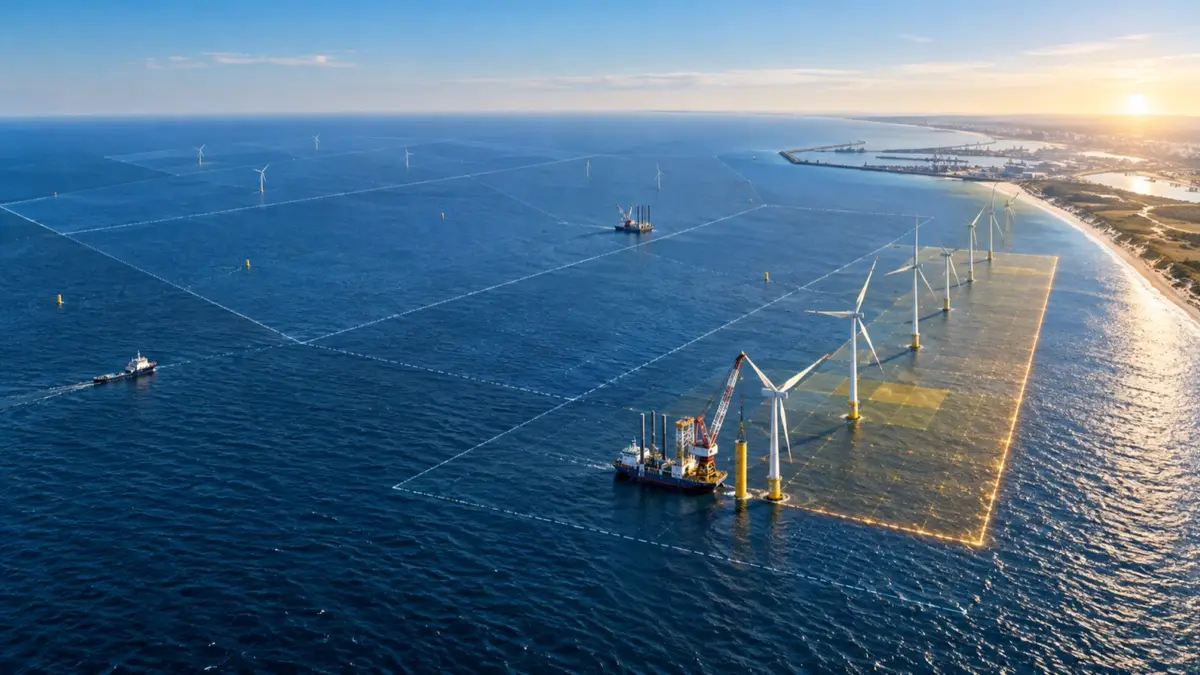
Romania offshore wind concession 2026: the Black Sea development areas, the Law 121/2024 framework, and what developers, suppliers and port investors should be doing before the first tender
One line in the draft concession rules matters more than the 11.5 GW headline, and most coverage has skipped it.
Winning a perimeter does not get you a grid connection. Award of the area and access to the network are separate processes, and the support mechanism is a third question that has not been answered yet. Anyone building a Romanian offshore model on the assumption that a concession delivers a route to market is modelling something that does not exist.
That said, what has happened over the past six weeks is the most substantial movement in Romanian offshore wind since the enabling law passed. The framework has gone from a map to an in force government decision, and the criteria you will be scored against are now visible. This is the window where preparation is cheap.
What closed on 27 August, and what opened four days later
Two separate processes converged on the same date.
- On 22 July 2026, the Ministry of Energy published the draft government decision containing the perimeter list under decision making transparency rules. Six zones, 11.5 GW, roughly 4,000 square kilometres of the Romanian Black Sea sector.
- On 17 August 2026, the Ministry published the draft government decision setting the concession rules, with comments accepted through 27 August 2026.
- On Thursday 27 August 2026, the Government approved the perimeter list. The consultation on the concession rules closed the same day.
- On 31 August 2026, in an extraordinary session, the Government adopted two further decisions: the specific concession norms together with royalty and fee levels, published as Government Decision 688/2026 in the Official Gazette Part I number 731 and in force from that date, and a decision on the reception of works for offshore installations.
The legal basis throughout is Law 121/2024 on offshore wind energy, adopted 30 April 2024. The package also discharges Milestone 116 under Component 6, Energy, of Romania’s National Recovery and Resilience Plan.
Worth stating plainly for balance: Article 7(3) of Law 121/2024 required the Government to approve the perimeter list by 31 March 2025. It arrived roughly seventeen months late, attributed by officials to a lack of financing for the specialist study the law required. A market that has just delivered its foundational instrument a year and a half behind schedule deserves to be assessed on execution, not on ambition.
The six zones, and what Phase 1 actually is
The 11.5 GW figure describes the full identified resource. It is not what is being tendered.
Phase 1 comprises three perimeters totalling 3.1 GW, all suited to fixed foundations with currently available technology:
- Area 1: 631 square kilometres, 1,900 MW
- Area 2: 149 square kilometres, 600 MW
- Area 3: 168 square kilometres, 600 MW
Together they cover roughly 1,000 square kilometres. Water depths run 55 to 75 metres. Average wind speed at 150 metres is 7.7 to 7.9 metres per second.
Phase 2 adds two areas at 1,800 MW and 800 MW. Phase 3 is a single 6,000 MW zone suited to a mix of fixed bottom and floating. The national target under the Energy Strategy 2025 to 2035 is around 3 GW installed by 2035, which aligns Phase 1 with the strategic objective and leaves Phases 2 and 3 as later decisions subject to further assessment.
For context on the ceiling rather than the plan: World Bank analysis puts Romania’s technical offshore potential at around 76 GW, of which roughly 22 GW is feasible with fixed foundations. Deployment scenarios for the Black Sea by 2035 sit in the 3 to 7 GW range. Total investment across the identified perimeters has been estimated at 16 to 27 billion euro.
The scoring grid, which is the actual news
For a first market entry, knowing how you will be ranked before the tender opens is worth more than knowing the megawatts. Several point values are already public from the consultation draft.
- Optional concession premium: up to 20 points
- Firmness of financial resources: 12 points
- Robustness of the financial plan: 8 points
The design intent is explicit in the framework: ranking is meant to reward implementation capability, financial sustainability and project viability, specifically to avoid competition based solely on price. The concession premium is a bid element, but it is capped in the tender documentation, which limits how far a balance sheet alone can carry an offer.
Qualification is assessed on technical and professional capacity, economic and financial capacity, relevant experience with offshore projects, and integrity. Article 9(2) of Law 121/2024 sets cumulative eligibility conditions covering insolvency, tax compliance, criminal convictions for corruption or fraud, outstanding EU state aid recovery decisions, undertakings in difficulty, and international sanctions. Article 10 requires operators controlled from outside the EU to obtain authorisation under Emergency Ordinance 46/2022, which is Romania’s foreign investment screening regime and a real gating item for some sponsors.
Two structural rules shape strategy. Consortia are permitted. And in the first round, a single bidder or its affiliates may secure no more than one area. That cap is the most important sentence in the document for anyone planning to take a dominant position: the maximum first round outcome for any one group is a single perimeter, so the 1,900 MW area and the two 600 MW areas will go to at least three different groups.
One caveat for accuracy. The complete point allocation is published with the tender announcement. Article 14(1)(d) of Law 121/2024 requires the announcement to contain a detailed description of the award criteria and the methodology for allocating points. What is public now is the architecture and part of the weighting, which is enough to shape a bid team, and not enough to finalise a bid.
Where the bonus points live, and why suppliers should care
Article 14(1)(e) of Law 121/2024 provides for non financial criteria carrying bonus points, awarded for commitments on local partnerships, local investment, use of port facilities, local workforce, professional training and environmental protection, subject to competition and non discrimination rules.
This is the part that converts a concession round into an industrial policy. For turbine and foundation suppliers, port operators and logistics investors, the relevant insight is not that Romania will build 3.1 GW. It is that the bidders competing for those perimeters will be scored on the strength of their Romanian supply chain and port commitments, which means they need those relationships in place before they bid, not after they win.
A developer assembling a bid in 2027 is a buyer of local partnership credibility in 2026. That is the commercial window, and it closes when the tender opens.
What it costs
Government Decision 688/2026 sets the financial regime, deliberately phased so obligations track activity rather than front loading a project with no revenue.
- Development stage fee: 800 euro per square kilometre per calendar year, from approval until commercial operation begins. On the 631 square kilometre perimeter that is roughly 504,800 euro per year.
- Operation stage fee: 1,500 euro per square kilometre per calendar year, applied to the constructed surface, including subsea cables running to grid connection points outside the concession perimeter.
- Royalty: 0.75 percent of revenues from exploitation of the park and electricity sales. The royalty base includes contract for difference payments where those apply.
- Royalty distribution under Article 41(3) of Law 121/2024: 80 percent to the state budget, 10 percent to the county budget, 10 percent to the local budget.
- Guarantees are required at four points: participation, contract execution, environmental obligations and decommissioning.
- Unit fee values are subject to annual indexation. The rates that apply are those in force at the date the concession contract is signed.
- Concession term: maximum 30 years under Article 15(1), with a single extension of up to 10 years.
- Direct agreements between the Ministry of Energy, the concessionaire and lenders are permitted, which matters for bankability.
Benchmarked against European offshore regimes, a 0.75 percent revenue royalty and a development fee under half a million euro a year on the largest perimeter is a moderate burden. The stated intent was to avoid compromising the feasibility of Romania’s first offshore projects, and on the published numbers that intent holds.
The post award clock
Winning is the start of a schedule, not the end of one. Article 21(1) requires ACROPO to issue the development approval within 60 days of complete documentation. Article 20(6) then requires construction to begin within 12 months of that approval, and the approval is valid for a maximum of five years from the start.
For a first of a kind offshore project in a market with no existing offshore wind supply chain, a 12 month construction start clock is the item to stress test hardest in any bid model.
What is still undecided
Objectivity requires listing what the framework does not yet answer.
- No date for the first competitive procedure. The rules exist, the perimeters are approved, the tender has not been announced.
- The complete scoring grid, with all criteria and weightings, arrives with the tender announcement.
- Grid connection. Award does not carry it, and Romania is simultaneously reforming network capacity allocation through a separate auction process. How an offshore concession interacts with that regime is not settled in public material.
- The support mechanism. Contract for difference payments are referenced in the royalty base, which implies a CfD, but the offshore support scheme is regulated separately and its terms are not published.
- Guarantee amounts. The four guarantee types are defined. The published coverage does not state the values.
- Phases 2 and 3 remain subject to further assessment, and the 6 GW floating zone depends on technology and economics that are not settled anywhere in Europe.
Why Romania is the right entry point for a 2027 move
The case does not rest on Romania being the largest offshore market in Europe. It plainly is not. It rests on five conditions that rarely coincide.
- A complete legal chain, now in force. Primary law from 2024, an approved perimeter list, concession norms in the Official Gazette, a fee and royalty regime with published numbers, and a works reception procedure. Most emerging offshore markets are missing at least two of those. Romania is missing the tender date and little else.
- A first mover position in an entire sea. The Romanian sector is the first part of the Black Sea to be opened under an EU regulatory framework. Bulgaria and the wider basin follow later, and a supply chain established for a Romanian Phase 1 is positioned for whatever comes next in the same waters.
- Scoring that rewards industrial commitment rather than the deepest balance sheet. The premium is capped, the local content criteria carry bonus points, and viability is weighted. That is a structure a credible industrial player can win from, not only a financial one.
- A cap that guarantees more than one winner. One area per bidder in round one means at least three groups take a position. For suppliers, that is three separate procurement programmes rather than one.
- Physical conditions that work with today’s technology. Depths of 55 to 75 metres and wind speeds of 7.7 to 7.9 metres per second in Phase 1 mean fixed foundations, proven equipment, and no dependence on floating cost curves that have not yet materialised.
The counterweights are real and should be priced. The perimeter list was seventeen months late. There is no tender date. Grid connection is a separate and currently uncertain process. The support scheme has not yet been defined. Romania has never built an offshore wind farm, and the port and vessel infrastructure to do so does not yet exist. None of that argues against entry. It argues for entering at the stage where positioning is cheap, which is now, rather than at the stage where it is priced, which is the tender.
Momentum Energy’s View
Our read is that the market is watching for the tender date when it should be reading the scoring criteria.
The tender date determines when capital is committed. The criteria determine who can credibly commit it. Those are different questions with different lead times, and the second one has a much longer runway. A developer that begins assembling Romanian port relationships, local partnerships and workforce commitments after the tender is announced will be building the weakest part of its bid under the tightest deadline, against competitors who started in 2026.
We would also separate the two things the 11.5 GW figure is doing. As a signal of national ambition it is useful. As a basis for a business plan it is misleading, because the tenderable universe today is 3.1 GW in three perimeters, capped at one perimeter per bidder. Investors should model the round that exists, not the resource that has been mapped.
The most underpriced element, in our view, is the bonus point structure for local content and port use. In most offshore markets, local content requirements arrive as an obligation that raises cost. In Romania they arrive as a scoring advantage in a competitive round that has not opened yet. That converts a supply chain relationship from a compliance cost into a bid asset, and it is available to whoever builds it first. For turbine, foundation, cable and port investors, that is the entire opportunity in one sentence.
For international capital, including the Turkish industrial, EPC and marine contracting groups already active in Romanian renewables and well positioned geographically for Black Sea logistics, the argument is the same one that applies across Romania’s current wave of energy reform. The country is early, procedural and dated. Early markets reward participants who are in place before the criteria are finalised, not those who read them when they are published.
Sources and references
Organisations and documents cited in this article.